

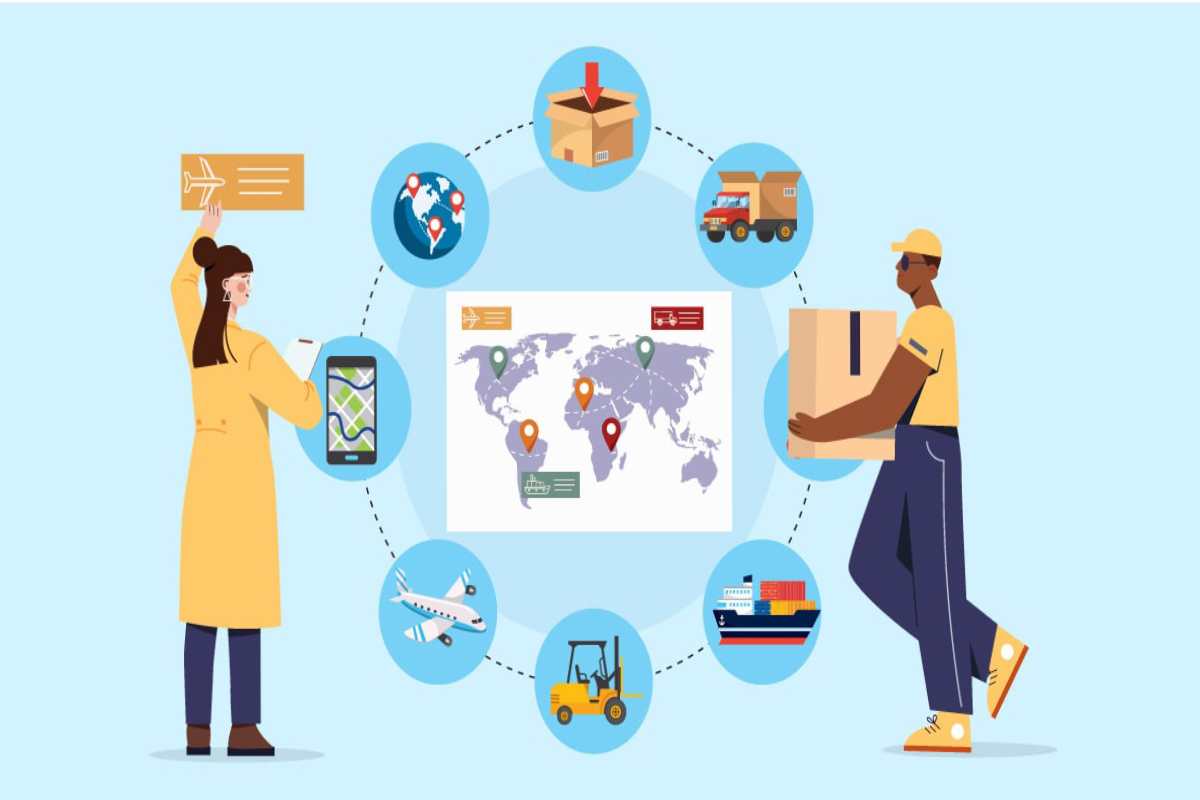
Trends in Supply Chains and Case Studies – How Can They Help Your Business?
Supply chains have been evolving a lot during recent years. Once businesses paid attention to purchasing materials at a proper cost, maintaining inventories and timely deliveries only. This is not enough nowadays, as there are many more aspects which need to be considered.
Today, customer demands are higher. Late delivery may quickly result in complaints from customers. A single disruption from a supplier may cause problems in production of goods even thousands of kilometres away. On the other hand, companies use more advanced technologies to forecast demands, control their inventories and operation.
This is why trends in supply chains are gaining in importance. Certain businesses pay attention to artificial intelligence and automation, while others are developing their efforts in supplier diversification, sustainability and better planning.
Case studies will help you to understand these changes.
1. AI in Supply Chain Management
AI is currently the most talked about trend in supply chain management.
Companies are using AI for applications like demand prediction, inventory management, route optimization, supply partner evaluation, warehousing, and risk management. For instance, an AI algorithm can analyze past sales performance, seasonality, and existing orders to provide estimates on future demand. In this way, planners will have another data source to consider when deciding on the level of inventory to maintain.
At the same time, AI technologies can help in detecting any irregularities. The fact that a supplier’s delivery times have become unusually long may be noticed by the system before this becomes a critical issue.
But AI does not substitute for business wisdom. Employees should verify data, comprehend the situation, and make an appropriate decision.
The most beneficial use cases are those that address a specific issue, rather than introduce a new technological solution per se.
2. The Relevance of Supply Chain Resilience is Increasing
Organizations have also begun recognizing risks in their supply chains.
The organization could rely on a specific supplier, mode of transport, factory, or commodity. Any disturbance with this node in the supply chain would cascade through quickly.
Resilient supply chain would imply being better prepared to cope with such disturbances.
The organization could maintain reasonable levels of safety stock, identify alternate suppliers, utilize alternate transportation paths, and even come up with a contingency production strategy.
This does not imply preparing for any conceivable emergency; this would be costly and hard to implement.
Rather, organizations should focus on identifying those risks that pose maximum harm.
3. Diversifying Supplier Sources
An additional trend to be considered is the minimization of excessive dependency on a single supplier or place.
Sometimes dealing with a single supplier may be more economical and convenient. However, it exposes a vulnerability when the supplier cannot supply.
For example, a food processing company may rely on one supplier of a certain type of packaging. In case the supplier faces some difficulties during production, the company will have all the components for production but still be unable to package the product.
Alternative supplier sources can help with this issue.
Nevertheless, dealing with multiple suppliers increases costs. Thus, companies have to figure out which supplies are significant enough to maintain multiple sources of them.
4. Improved Supply Chain Visibility
Companies need visibility in their supply chains to understand how everything is working out in their business without having to wait for any issue to arise.
Visibility in supply chain management can consist of details like inventories, orders from suppliers, production planning, shipping details, and even customer deliveries.
Improved visibility does not necessarily cost you money. Sometimes just knowing about your inventories will be enough
5. Automation in Warehouses and Logistics
Automation is another emerging trend.
Big warehouses process millions of items per day. Repetitive tasks, like sorting, scanning, picking, and transporting of items take a lot of time.
Automation and robots can be helpful in performing these tasks.
For instance, DHL introduced robots in their warehouse operations. According to the report by DHL, the number of picks performed through their robotics collaboration with Locus Robotics was already 500 million across over 35 DHL sites.
What small businesses should learn from this is not the necessity to install robots in all warehouses.
What These Case Studies Teach Us
These examples have something in common. The companies are not using technology simply because it is fashionable.
They are trying to solve specific problems.
One business may need better forecasting. Another may need improved warehouse productivity. Another individual might require greater insights on the risks present in the supply chain.
It is a very relevant issue for small enterprises.
A firm doesn’t have to duplicate whatever is done by a multinational enterprise. Rather, it needs to identify the major risk it faces in its supply chain and develop an appropriate solution.
For a small retailing business, accurate inventory is much more useful than the installation of artificial intelligence systems. For a manufacturing organization, identifying a dependable backup supplier will come first.

Steps to Prepare for Future Supply Chain Modifications
Enterprises that wish to remain well-prepared can take the following simple actions.
Firstly, gain knowledge about the current supply chain. This means that you should know your important suppliers, the location of your inventory, and the places where delays commonly occur. Secondly, follow important performance indicators. These can be the time taken for delivery, the quantity of your inventory, the performance of your supplier, the accuracy of orders, and transportation costs.
The consideration of important risks is also important. It is also worth reviewing important risks regularly. A supply chain that was reliable last year may have new weaknesses today.
Finally, introduce technology gradually. Start with a real problem and choose a tool that addresses it.
Conclusion
The future of supply chain management is not focused on any single technology. While artificial intelligence, automation, real-time monitoring, sustainability and diversified sourcing are all necessary for efficient supply chains, all these are useful only if used with a specific goal in mind.
The most successful companies in terms of managing their supply chains are the ones that have a good knowledge of their operations, react quickly to any changes and make improvements before the problems become critical.
For new companies that begin implementing supply chain improvement strategies, there is no need to make too many radical changes at once. Good inventory management, improved relations with suppliers, communication and performance tracking will be enough for the initial phase.