

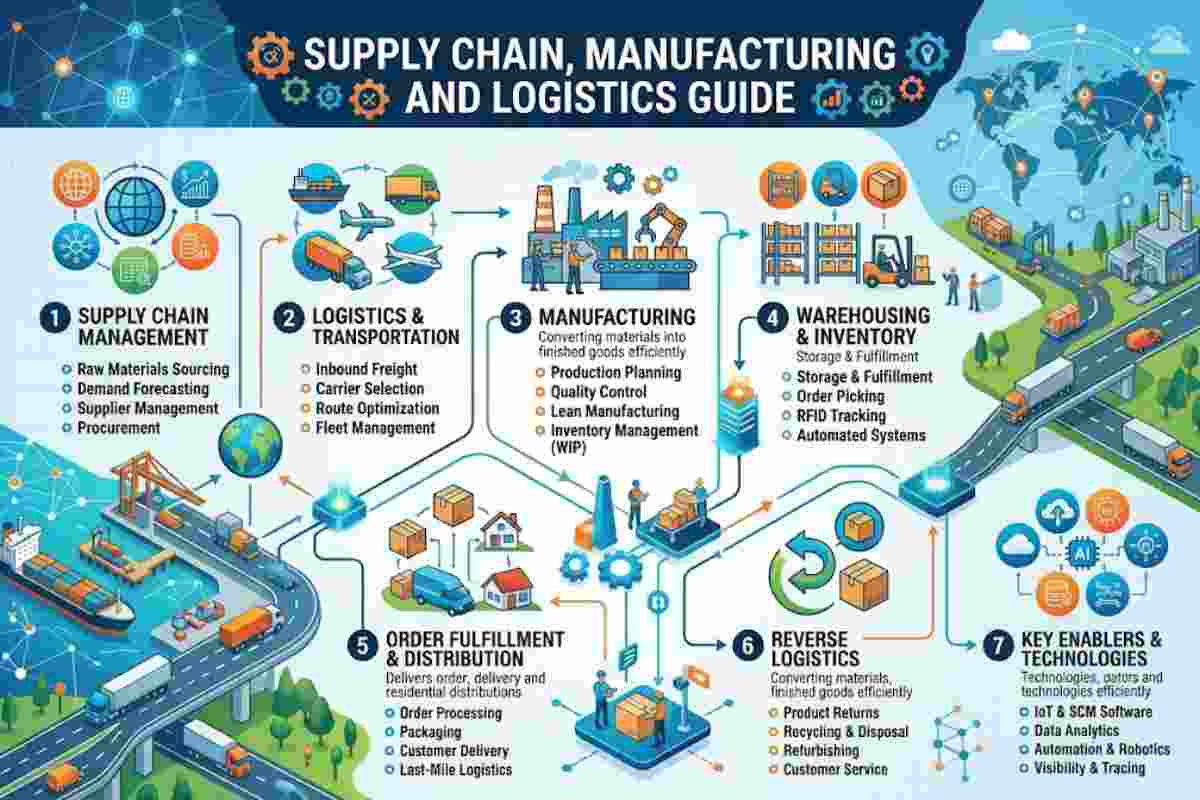
The Supply Chain, Manufacturing and Logistics Guide: How Businesses Move Products from Source to Customer
Supply Chain Manufacturing and Logistics Guide – When a product gets to a customer it looks pretty simply. A lot of work goes on behind the scenes to get it there. Someone has to find the materials talk to supplier’s plan what to make keep track of stock, run warehouses, set up transportation follow orders and deal with problems that come up. When all these things work together, the customer does not notice much. But when something goes wrong it can happen fast: production stops, orders are late stock runs out and costs go up.
This is why supply chain, manufacturing, and logistics management are important to businesses of every size.
A good supply chain is not about moving boxes from one place to another. It is about working with people, materials, information, money, technology and processes so that products can be made and delivered quickly. Supply chain management includes a lot of activities while logistics focuses on storing and moving goods. Manufacturing connects the two by turning materials and parts into products that customers can use.
For a manufacturer this might mean buying raw materials from a few suppliers and delivering finished products to local stores. For a company the network may include suppliers from other countries, factories, distribution centers, transportation companies, warehouses, stores and millions of customers.
Understanding how all these pieces work together is the step, to building a more reliable and cost-effective operation. Supply chain, manufacturing and logistics are all. Work together to get products to customers.
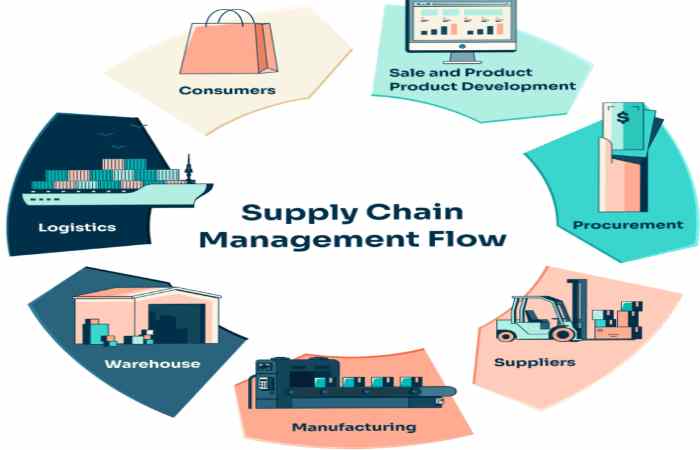
Supply Chain vs Manufacturing versus Logistics
It is about managing the process of getting materials and products and information from suppliers to customers.
Manufacturing is the part where they make things. They take materials or parts and turn them into finished products or products that are not yet finished.
Logistics is about moving things and storing them and giving them to people who ordered them. These services include transporting the goods and keeping them in warehouses and sending the orders to customers.
As an illustration, suppose there is a company manufacturing kitchen equipment such as refrigerators. The supply chain management part is about finding people to supply steel and other parts and boxes to put the appliances in. The manufacturing part is about putting all those things to make appliances The last one, which is logistics, is all about transporting all the pieces to the manufacturing plant and storing the completed appliances, and delivering them to either the retailers or directly to the consumers.
These three processes rely on one another for successful operation. A manufacturing facility producing goods cannot operate effectively without necessary raw materials. The products produced cannot bring profit if they do not reach the consumer.
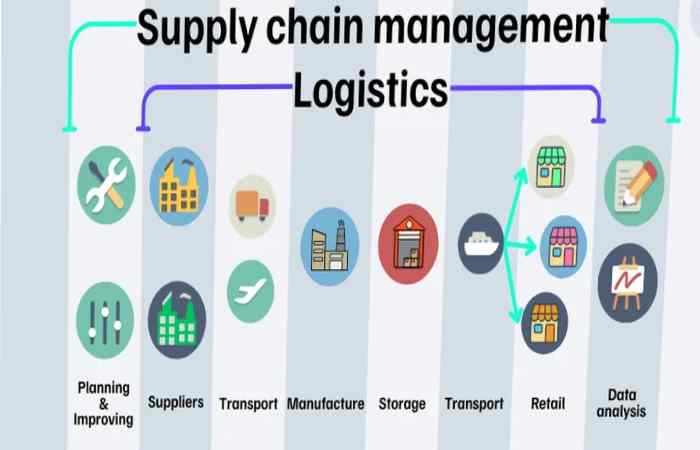
Key Stages of the Supply Chain
Supply chains may vary in different industries, but most of them usually consist of some standard stages.
-
Planning
The process of planning forms the base on which the whole supply chain will operate.
There is a need to forecast customer demand, production needs, plan inventories and allocate resources. The planning process in a supply chain may involve forecasting the demand, planning for inventory, production scheduling, procurement, and logistics.
Good planning need not involve predicting the future. The demand may be uncertain. All that needs to happen is that the right decisions have to be made based on the available information.
2. Sourcing and Procurement
Procurement involves finding and purchasing the goods, equipment, and services required by the business.
Effective procurement goes far beyond finding the best deal. A number of factors including delivery time, quality, reliability, production capacity, payments, and risk may impact the purchase.
The supplier who offers the best prices might not be the ideal choice where delivery time and quality are concerned.
Good relationships with suppliers may also help in making communication easier in cases of demand changes and disruptions.
-
Manufacturing
Manufacturing processes are the transformation of materials and components into finished goods.
The production process may vary from company to company, including the use of assembly line operations, machines, workers, automation, and specialized processes, among others.
Manufacturing staff normally face competing demands, such as:
- Production rate
- Quality of the product
- Availability of labour
- Availability of equipment
- Availability of materials
- Production cost
- Customer demands
- Safety
An otherwise highly efficient manufacturing schedule may be ruined by the lack of availability of the required raw material or the breakdown of machinery.
4. Inventory Control
The process of inventory control consists of understanding how much inventory a firm possesses, its location and when additional inventory would be required.
Examples of inventories are raw materials, components, work-in-process items, finished goods, packing and spare parts.
Excessive inventory could raise storage costs and lock-up working capital whereas inadequate inventory would lead to shortages.
Therefore, it becomes essential for a company to establish suitable levels of inventory, reorder points and safety stocks.
5. Warehousing
Warehouses are more than just places where things are stored. Effective warehouses will receive materials, inspect the materials, store them in the right way, keep track of inventory, select the order, package the items, and prepare them for shipment.
Organized warehousing can directly affect productivity. If the frequently requested materials are hard to find, employees waste time looking and correcting mistakes.
There are technologies that may be employed to increase efficiency such as barcodes, warehouse management software, scanning tools, and automation equipment.
Production planning makes decisions about what should be produced, how much is needed, timing of production, and necessary resources.
The managers may be required to make decisions on:
- Available raw materials
- Workforce capacity
- Machine availability
- Production lead times
- Customer orders
- Forecasted demand
- Maintenance schedules
- Quality requirements
When production planning takes place without coordinating with purchasing, a company may plan to produce a product which may not be possible because the component required for production is not available yet.
It is for this reason that communication between procurement, production, inventory, sales, and logistics personnel is vital.
Lean Manufacturing and Waste
The concept of lean manufacturing involves enhancing processes by eliminating activities that do not add value to the process.
Waste may assume different forms such as waste in motion, waste in waiting time, waste in excess inventory, and so forth. The purpose is not simply to make employees work faster. A good lean approach looks at how the overall process can be improved.
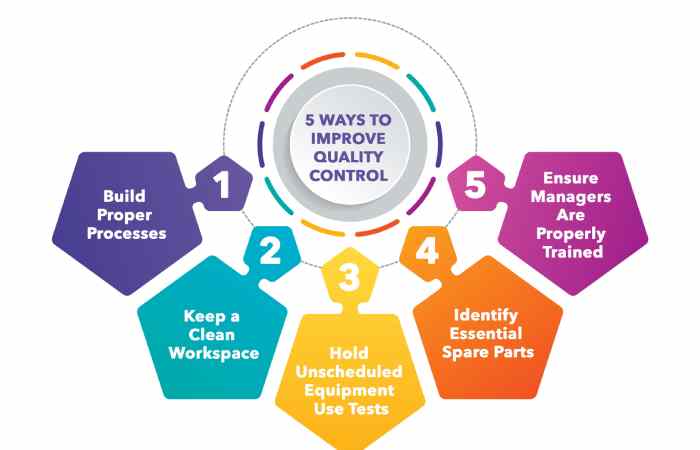
Quality Management in Manufacturing
Producing goods quickly is not enough if the products fail to meet expected quality standards.
Quality management should be considered throughout production rather than only at the final inspection stage.
Businesses may monitor:
- Material quality
- Production specifications
- Equipment performance
- Defect rates
- Packaging
- Customer complaints
- Returns
- Corrective actions
Automation in Manufacturing and Logistics
Automation can improve repetitive processes and reduce certain forms of manual work.
Examples include automated material handling, barcode scanning, robotic equipment, automated storage systems, and production monitoring.
However, automation should be approached realistically.
A business should first understand its existing process. The automation of a badly-designed process will only speed up its problems.
Companies need to take into account the cost, benefit, maintenance, staff training, compatibility with their current system, and other factors before investing.
Supply Chain Risk Management
A supply chain can be impacted by circumstances that are out of the control of the business. Risks may include:
- Supplier failure
- Transportation delays
- Natural disasters
- Labor shortages
- Equipment breakdowns
- Sudden demand changes
- Regulatory changes
- Geopolitical disruptions
- Cybersecurity incidents
Businesses can then develop practical contingency plans.
The goal is not to eliminate every possible risk. That would be unrealistic and often too expensive. The goal is to understand important risks and prepare proportionately.
Sustainable Supply Chain Management
Sustainability is one more component to be taken into account apart from cost, quality, and service. There are methods through which firms can look to cut down waste, make packaging efficient, use transport more efficiently, cut down unnecessary handling, and collaborate with suppliers who satisfy environmental and social expectations.
It does not necessarily involve a complete overhaul of the operations in a matter of a day.
The firm may start with cutting down packaging waste, routing deliveries more efficiently, increasing recycling, repairing, and reuse of the products, and measuring consumption of resources.
Such changes can be introduced without much disruption and in the support of corporate objectives.
Improving the Efficiency of the Supply Chain
Companies wishing to improve their supply chains could start off with realistic measures instead of trying to implement every measure at one go.
Begin with analysing the movement of materials and products from suppliers to customers and see where there are unnecessary delays, extra costs, mistakes, and duplication of efforts.
Then take a look at inventory levels and suppliers. Find out what materials and suppliers are truly important.
Increase communication between different departments so that the sales forecast, production planning, purchasing, and logistics schedule are all made using the same data.
It would be worthwhile to examine transport systems and warehouses periodically as well since small measures may yield significant results in some cases.
Lastly, it would be useful to base decisions on performance metrics. Identification of what needs to be done is going to be hard for the company because it does not understand where the problem is coming from.

The Future of Supply Chain, Manufacturing and Logistics
Technologies, Information, Automation and Real-time decision making will be increasingly significant within the supply chain.
The supply chain will increasingly be reliant on technologies, information, automation and real-time decision making. There is an effort to come up with a more efficient way of forecasting demand, managing inventories, improving warehousing practices, optimizing logistics, and reacting to disruptions.
However, there is no substitution of the need for an experienced person who will make sense of the information, make compromises, talk to suppliers, coordinate people, and react in case the reality is different from the plan.
The future, therefore, might be a fusion of the two.
The firms that manage to connect their information with experience will find advantage in the changes of needs from customers and suppliers.
Supply Chain Manufacturing and Logistics Guide, F & Q
What is supply chain management?
Supply chain management is the integration of processes that deal with procurement of materials, manufacturing, stocking, transporting, distributing, delivering, and returns. It involves the management of flow of products and information from suppliers to consumers.
What is the difference between a supply chain and logistics?
The concept of supply chain management is much broader as it involves planning, procurement, manufacturing, stocking, delivery, while logistics is a major component of the supply chain management and deals mostly with transportation, storage, movement, distribution, and other activities.
Why is inventory management important?
Inventory management allows companies to stock enough of products to satisfy the need of customers without keeping too many products in stocks.
How can manufacturing efficiency be increased?
Companies should analyse production processes, decrease waste, increase maintenance, improve quality control, better coordinate materials, and utilize technology.
What is reverse logistics?
Reverse logistics is responsible for overseeing the flow of goods in reverse from customers or any other stage in the supply chain.
Why are the risks in the supply chain so crucial?
It could be because an issue in one stage might impact the rest. Knowing about the risks and developing feasible solutions could help the business run during times of uncertainties.
Conclusion
Supply chain management, manufacturing, and logistics are interrelated disciplines in today’s business environment. While a company might have an outstanding product, it takes far more than just production for its consistent delivery to consumers.
Supplies should arrive in time. Manufacturing has to function well. Inventory has to be managed. Warehouses have to be maintained. Logistics has to be arranged. Orders must be processed.
The most efficient supply chains are not always those that possess state-of-the-art technology or large-scale warehousing facilities. Rather, they are those where people, procedures, suppliers, information, and resources are aligned towards the set business objectives.
In order to enhance their performance, organizations should begin by doing something that seems too basic – understand how the existing supply chain functions, pinpoint the problematic areas, measure what is measurable, and gradually improve the individual processes.
Such approach results in a highly efficient and highly adaptable supply chain, which can adjust to new consumer demands, supplier situation, or overall environment changes.