

What Is a Monopoly Market?
Monopoly refers to a form of market structure in which one firm has the ability to control the production of a particular commodity in the market, with minimal competition from other firms.
There are numerous reasons why a monopoly may be created. For example, there may be a situation where the company has access to certain technologies or resources that cannot be acquired by other firms. There may be situations where the government laws or patents protect the monopoly firm from other firms joining the market. In such cases, the structure and size of the organization can also influence how effectively it manages its resources and maintains its position in the market.
Features of Monopoly
There are usually certain features associated with a monopoly, including:
Only one large producer: This is the only company that produces almost all or even the entire output of a particular commodity or service.
>Low level of competition: The consumer does not have any other sellers in the market.
>Higher cost of entry: It might be costly for a new firm to enter into the same industry.
>Price setting power: The monopoly enjoys a higher price setting power compared to a firm operating in an environment with stiff competition.
No close substitutes: The consumers have limited options of substituting their choice of commodity or service.
How Does a Monopoly Work?
In a monopoly, the firm determines its production and prices taking into account consumer demand, cost structures, and market dynamics. Given that there is a lack of competition or that competition is virtually non-existent, the firm does not have to make adjustments to competitive offers, unlike companies functioning within a competitive market structure. Payment systems and financial services can also form part of how businesses collect revenue, making platforms such as Payhub relevant when discussing business transactions.
Nevertheless, even being in a monopoly position, a firm cannot charge whatever prices it wishes to – the prices will be too high, and consumers will simply cut down the volume of their purchases or resort to other products or services. The company also needs to consider whether its pricing decisions can keep the business profitable while maintaining enough demand from consumers.
To illustrate, consider the case of a sole supplier of a certain type of service in a certain area – consumers who need that service will have to turn to that company. It will possess considerable market power.
Nevertheless, even being in a monopoly position, a firm cannot charge whatever prices it wishes to – the prices will be too high, and consumers will simply cut down the volume of their purchases or resort to other products or services.
Example of Monopoly
An illustration of a monopoly could be a utility company working in an area that makes it very costly to set up a second network. This is because of the costly nature of the infrastructural investments, which might make it hard for another firm to come in and compete. In other industries, a company may also focus on a specific niche market where there are fewer competitors and a smaller group of customers with particular needs.
An illustration of a monopoly could be a utility company working in an area that makes it very costly to set up a second network. This is because of the costly nature of the infrastructural investments, which might make it hard for another firm to come in and compete. Large infrastructure projects often require structured planning, coordination, and monitoring, which are activities commonly supported by a Project Management Office (PMO).
Monopoly in its name refers to a specific situation in the market. This is a situation whereby the producer or the seller is the only person who sells a commodity or service and has all the powers.
A monopoly exists when in the market economy there is a single seller or producer of an element that serves to satisfy the needs of the entire sector and can arise in different ways: the association of several companies that are under the control of the same address (a trust );
The agreement between companies of the same economic sector to achieve the elimination of competitors (a cartel); the treaty that gives certain sellers a monopoly on a product or a sector (a seat); or the purchase or merger of companies.
Find Some Types of Monopoly :
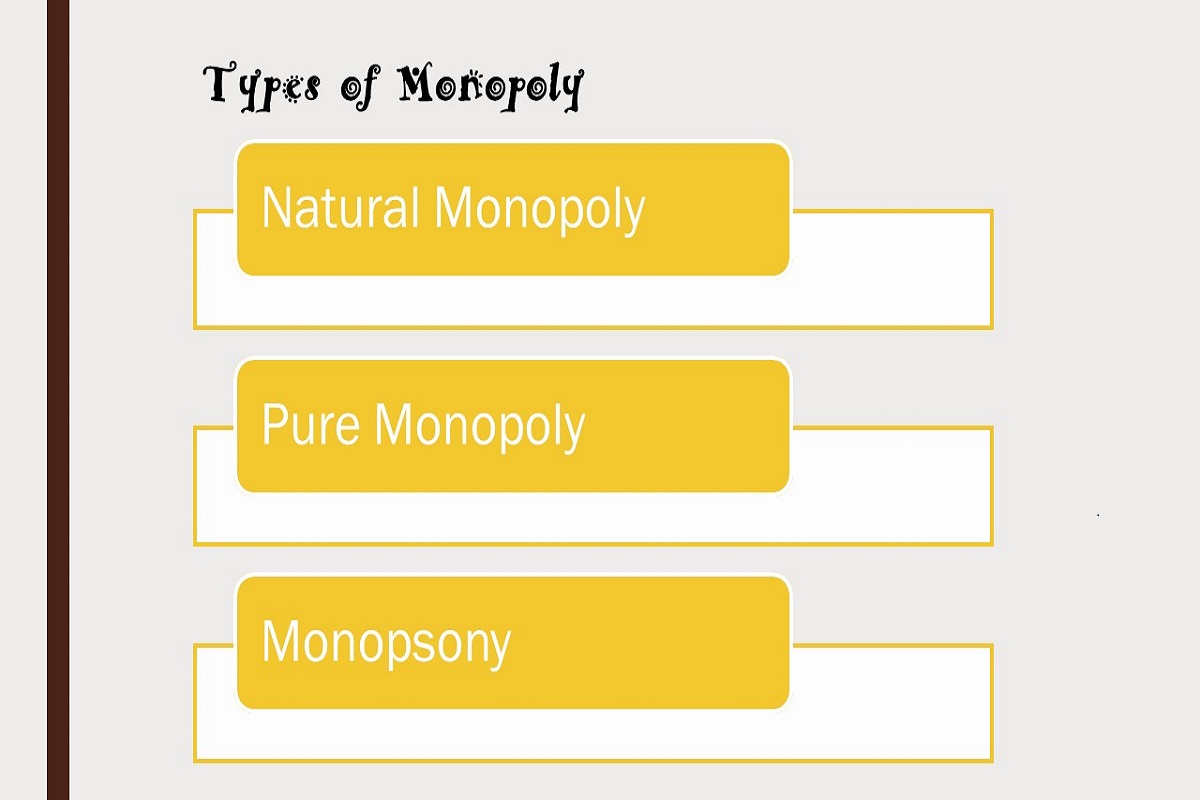
Natural Monopoly is one that is created from the demands of consumers. It emerges fluidly and becomes the leader in the production of that element or service. This type of monopoly cannot handle prices at will but must accept certain limits, such as potential competition, the constant competitive factor, the elasticity of demand, substitute factors, and the law of yields.
Pure Monopoly is what results when there is only one person or company that produces and distributes a product in a market where there are many buyers. In the real economy, this type of monopoly does not usually occur except when it is an activity that has been ceded by a public operation.
A pure monopoly is only possible when there is a single seller; this means that there are no rivals. However, the monopolist will be restricted by indirect competition and competition from goods that can replace the one that offers and contain a price more reasonable. Finally, before the entry into the market of competition, the monopolist must take measures to prevent its power from diminishing. For businesses operating in less concentrated markets, identifying a new business opportunity can also create a way to enter an industry and compete with established firms.
A monopsony is a market formed by a single buyer and many sellers.
In these markets, the monopolist has to pay a higher price for the last unit of the input and on the units previously acquired. The competitor of this vendor is the input market, which can be somewhat detrimental to the monopolist’s economy. It should be noted that similar cases, but where many buyers are present, are called oligopsonies.
Thanks to its power, therefore, the monopolist can control the price and quantity of production. To fix these variables, it usually analyzes costs and market demand. So he decides how much he will produce and at what price the marketing will materialize.
In short, for there to be a monopoly, other goods or services that replace those offered by the monopolist should not be found in the market. Said product, in short, is the only one that the consumer has to acquire. There is no competition or the possibility to compare quality between similar products.
Conclusion
We can also add that in the market terminology, a good monopoly is denominated to the one that is born voluntarily, with the approval of the majority of consumers and within a democratic process. Anyway, a monopoly that at first seems good can present anomalies that make it harmful for the normal functioning of the market in that society.