


Supply Chain Blunders: Issues That Businesses Need to Avoid
Supply Chain Common Mistakes—At first sight, a supply chain might seem to be a straightforward process to manage. However, for it to operate efficiently, it needs proper planning. Raw materials need to be bought, stored, processed, delivered and distributed on schedule. Any error made during any stage can result in major problems for all others.
For example, in case the delivery of raw materials provided by the supplier gets delayed, production process will get affected. In case the inventory management system breaks down, it will mean that the company delivers to its customers the goods which are not actually available with the company. Logistics poorly designed will increase costs of the delivery process.
1. Not Maintaining Proper Inventory Records
One of the biggest errors in the supply chain process is having inaccurate inventory information.
A company may have an idea that it has 500 items in its inventory while there are actually 350 of them. This may be caused by spoiled goods, wrong data entry, lost products, returns, and just counting errors.
Inaccurate inventory data brings troubles for buying, selling, and warehousing departments.
Inventory audit will help determine the discrepancies between actual and recorded inventory counts. Barcode technology and inventory management software may also eliminate human errors.
2. Order Excess of Inventory
Having enough inventory is not bad per se but too much inventory is a costly issue.
The products have to be stored, handled, insured, sometimes kept under specific conditions. There are even products which can spoil, deteriorate, or become hard to sell.
For instance, a store purchases a lot of a particular seasonal product from a vendor who has a promotion. Customer interest in this product proves to be lower than anticipated and the store ends up with excess inventory.
Businesses have to take into account demand, lead time, storage expenses, and the product’s shelf-life before ordering a large amount of
3. Keeping Too Little Stock
The other issue can also be equally harmful.
When there is not enough inventory kept by a firm, the firm might end up having shortages of goods whenever there is need for them. This might cause loss in sales and dissatisfied customers.
For manufacturers, there is a greater risk that they will be faced with when they are out of necessary raw materials.
The aim should not be to have maximum inventory but to have an adequate one.
4. Choosing Suppliers Only by Price
The price is important while choosing the suppliers, but it should not be the sole factor in such decision.
The supplier who offers a lower price can deliver materials late or offer an inferior quality. Consider two suppliers offering the same materials. The first supplier offers lower prices but often makes late deliveries. The second one costs a little more, but delivers in time.
The latter supplier may be more useful because of frequent deliveries to ensure continuous production process.
These organizations have to take into account many aspects when evaluating their suppliers, including price, quality, reliability, lead-time, communication, and flexibility.
5. Overreliance on One Supplier
Dependence on one single supplier can be very risky.
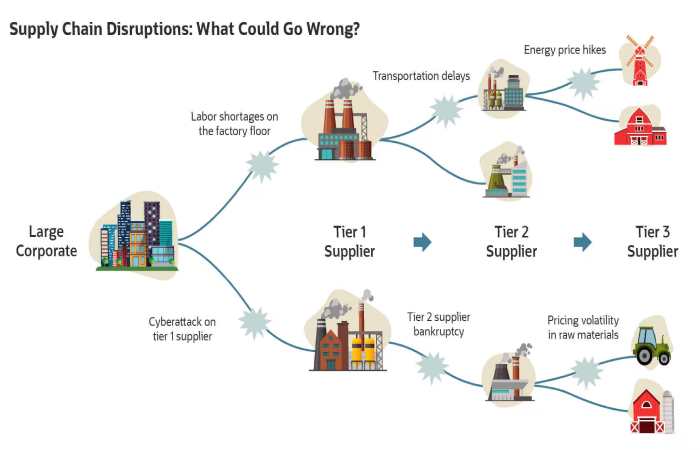
In case such a supplier faces any factory problems, shortages, transport problems, or financial problems, there could be no other choice left.
This is not to say that a firm has to have more than one supplier for every material that they use.
However, where risks are great enough, firms must explore alternate sources.
6. Bad Communication Among Departments
Supply chain management operations are interlinked and require information exchange. The sales department may be aware of rising demands. The purchasing department may be aware of delays with the supplier. The warehouse department may be aware of incorrect inventory reports.
If there is no communication among these departments, decisions made by managers will be based on incomplete data.
Communication among the sales, purchasing, production, warehouse, financial, and logistics departments can help solve a lot of issues.
7. Not Taking Care of Supplier Performance
Locating the supplier is not the end of the story. Businesses must monitor if the supplier is performing as expected.
It can be helpful to check:
- Delivery times
- Product quality
- Order accuracy
- Pricing
- Communication
- Response to problems
If a supplier’s performance has been deteriorating for several months, then the organization needs to discover the cause of the problem rather than continue doing what they have always done without questioning.
8. Poor Demand Forecasting
Demand forecasting assists organizations in determining the level of inventory and production that might be necessary.
Poor forecasting results in either having too much stock or shortage of stock.
For instance, an organization may estimate that the next month’s demand will be exactly the same as the current month’s demand, but this is not the case because of the introduction of a holiday, promotions, change in price, and entry of a new competitor into the market.
Forecasting should be constantly analyzed and adjusted based on any new information that emerges.
9. Failure to Consider Lead Time
Lead time is defined as the period needed to complete a process.
A supplier may need two days to supply a particular product and three weeks for the other product. Purchasing teams need to take such considerations into account to avoid placing orders late.
Lead time needs to be considered when setting up re-order levels and production.
10. Disorganization in the Warehouse
The size of the warehouse will not determine whether or not the space is well organized.
Goods stored in improper locations will take longer to locate.
A practical layout of the warehouse would ensure that items that are often used are easily accessible and that the storage places of goods are clearly marked.
Proper stock keeping and labeling of goods would help in reducing warehouse errors.
Ways of Avoiding Common Supply Chain Mistakes
Companies can minimize many supply chain issues by doing just a few practical things.
The first step is having accurate information. The inventory and supplier data should be updated on a regular basis.
Information about demand changes, purchasing and delivery should be communicated across the department.
The critical raw materials and suppliers need to be identified and contingency plans prepared for any big risks.
Finally, supply chain performance needs to be evaluated on a regular basis. What works, causes delays and increases costs in the process should be noted.
A small change can make a great difference if done everyday.

Concluding Remarks
The consequences of supply chain errors are not limited to the warehouse or procurement department. It might lead to higher expenses, delays in the process of manufacturing, delivery issues, and customer dissatisfaction in the end.
Common errors that occur in businesses generally revolve around a couple of aspects: inventory inaccuracies, poor supplier management, bad communication, impractical forecasting, inefficient warehousing, and absence of readiness to address the disruptions.
Companies do not need to minimize all risks to have a trustworthy supply chain. All they need to know is what challenges exist in their business and try to solve them.
Effective supply chain management must include proper data, efficiency in the process, communication, and decision-making. Smaller companies can greatly benefit from learning about mistakes that people tend to make and creating appropriate procedures to prevent them.