

Retention Strategy: The Strategy to Retain Excellent Employees
Retention Strategy – Finding good employees can take a lot of time and resources. However, hiring good employees alone cannot be enough to have a well-trained staff. Companies should also provide good incentives for keeping them.
That is why having an efficient employee retention strategy is essential.
Employee retention refers to the creation of a working environment where the employees are able to perform their duties efficiently, receive the chance to develop and realize their potential, and know that their work is appreciated. It does not involve retaining all employees forever; rather, the goal is to ensure reasonable and helpful conditions for skilled employees.
A good retention strategy will help avoid unnecessary turnover and preserve the precious information.
What Is an Employee Retention Strategy?
An employee retention strategy is a systematic way through which an employer attempts to keep the employees within the organization.
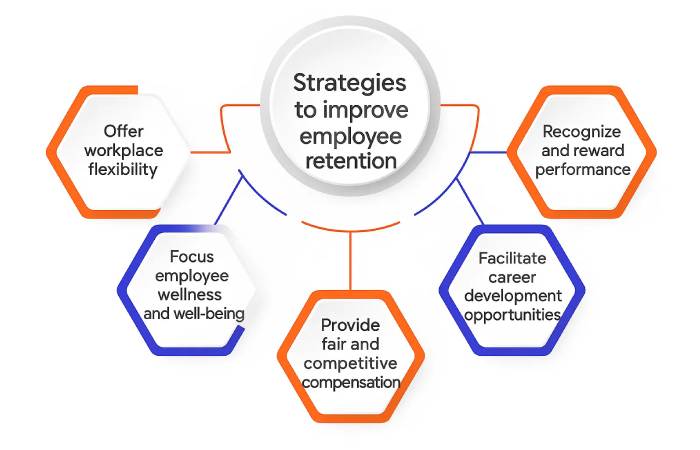
There are many factors that can lead to an employee quitting a job. The remuneration may play a role in some cases, but it does not have to be the sole determinant. Some of the factors that can affect an employee’s retention include:
- Management
- Fair compensation
- Career development
- Recognition
- Training
- Supportive management
- Healthy workplace communication
- Flexible work arrangements where appropriate
- Clear expectations
- Opportunities for growth
- Employee feedback
The best approach generally involves a combination of some of the above areas instead of focusing on just one approach.
Why Employees Resign
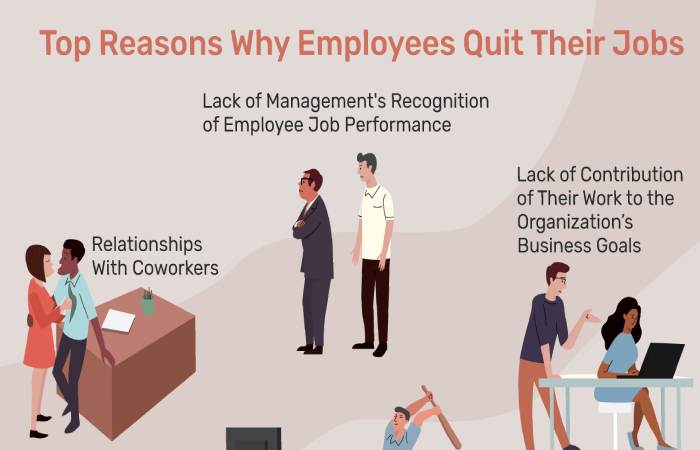
Prior to developing a retention plan, it’s important that companies know why employees resign.
This can be achieved without making assumptions by:
Employee surveys
- Exit interviews
- One-to-one conversations
- Manager feedback
- Retention data
- Anonymous feedback channels
- Identify trends rather than focusing on a specific problem.
- For instance, if multiple employees point to lack of career opportunities, then your company needs to evaluate its developmental policies. When there is repeated complaints about ambiguous expectations, it means that you have a problem with management and communication.
Offer Competitive and Fair Compensation
Salary is one of the most important aspects of retaining employees.
- Your employees must feel that the remuneration received corresponds to the amount of responsibility associated with the position and the employment market.
- Firms need to periodically analyze their employees’ salary packages and decide if it is fair or not.
- However, it should be noted that increase in salary will not always work as a way of retaining employees because the person may resign due to poor management, overload, or bad working conditions.
- Therefore, compensation should be analysed together with other elements of the work process.
Create Career Development Opportunities
Employees are thinking about their future when there are certain development possibilities for them.
Career development doesn’t necessarily have to be in a form of promotion. The following can be considered as career development options:
- Learning new skills
- Taking on additional responsibilities
- Working on different projects
- Mentoring
- Leadership training
- Professional development
- Cross-training
Managers should talk to the workers about their interest and development.
Even though promotion may not be feasible at present, showing workers that they can develop themselves makes their work purposeful.
Recognize Good Work
- The worker needs to feel that his efforts are acknowledged.
- Not always recognition requires monetary compensation; sometimes it may consist of a sincere “thank you” or positive feedback from the boss, acknowledgment of the good work done.
- For the recognition to be effective, it should be specific.
- In contrast to simple “good job,” it would be better to tell the person what exactly he did right.
- Regular recognition will help to build an atmosphere in which the employees’ work is recognized as valuable.
Support for Managers and Team Leaders
The worker usually perceives the business environment through his/her manager.
Supportive manager may help the workers to solve different problems, give priority to different tasks, to get feedback and develop. The poor manager, vice versa, can create frustration.
In order to be able to perform their role effectively, the managers should be provided with the following:
- Communication
- Feedback
- Conflict management
- Delegation
- Performance management
- Employee development
- Workplace policies
Managers must also have an idea of when an issue should be referred to HR.
Have Good Communication at the Workplace
Poor communication causes unnecessary stress.
Employees must know what is expected of them and where they can vent out their problems.
Good workplace communication includes:
- Clear instructions
- Regular updates
- Active listening
- Constructive feedback
- Team discussions
- Accessible managers
- Transparent communication about important changes
Communication should not be a response to a problem alone. It can help the managers realize where things stand with their subordinates before it turns into an issue.
Manage the Workload Carefully
- The individual might like his job but may get frustrated when there is too much workload.
- The managers need to keep track of the workload and priorities on a consistent basis.
Consider the following question:
- Is the deadline feasible?
- Are responsibilities clearly divided?
- Is additional support needed?
- Are employees regularly working beyond reasonable expectations?
- Are low-priority tasks taking time away from important work?
Workload management does not mean removing every challenging task.
It means setting realistic expectations and having proper resources.
Work-Life Balance
Workers have other commitments apart from work, and those companies that keep this aspect in mind will definitely come up with a sustainable working environment.
This will depend on the nature of the work but may include all of the following:
- Flexible schedules
- Remote or hybrid work
- Appropriate leave policies
- Predictable working hours
- Reasonable meeting schedules
All companies will not be able to provide the same amount of flexibility. The point is to be practical in regard to what the position requires and apply workplace policies consistently.
Retention Strategy Checklist for Employees
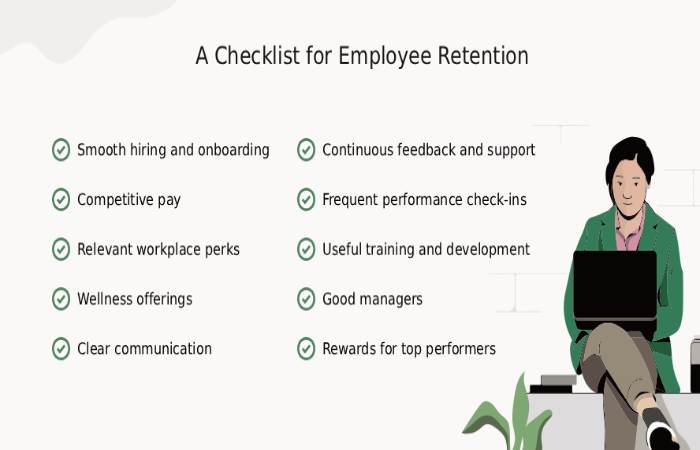
Use this checklist to review your retention strategy:
- Evaluate employee turnover periodically
- Find out the reason behind employee turnover
- Check the compensation and benefits package
- Offer career development opportunities
- Acknowledge achievements
- Train managers
- Communicate effectively
- Evaluate workloads
Concluding Remarks
A successful retention strategy does not lie in finding that one thing that will appeal to everybody and make them all want to stick around. Employees’ needs are diverse and may change through time.
The most efficient way would be to foster such environment in which employee know their role, get treated fairly, have chances to grow and know that their job is appreciated.
A company must also consider the experience of its employees from day to day. Good communication, an appropriate workload, effective management, and appreciation and growth opportunities are extremely important.
When companies hear their employees and act accordingly, retention becomes not just a number that needs to be achieved by the Human Resources department. Retention becomes a part of building a stable and healthy work environment.