


Legal Trends and Case Studies in Business Law: What Businesses Should Know
The field of business law is evolving rapidly. The current legal challenges that businesses face today are different from the ones from a few years back, and now include challenges such as artificial intelligence, data privacy, cybersecurity, online contracts, remote work, and increased regulation.
For the modern businessman, being up-to-date on these developments is no longer just a task of the legal department. This could have an impact on decisions involving marketing approaches, recruitment process, technological adoption, relationship with clients, and many others.
Based on compliance research that has been done recently, cybersecurity and data privacy continue to be the top legal issues for business organizations, whereas the emergence of artificial intelligence brings up new legal issues regarding accountability, transparency, intellectual property, and automation.
In this book, the reader can learn about some important legal trends and business cases in business law.
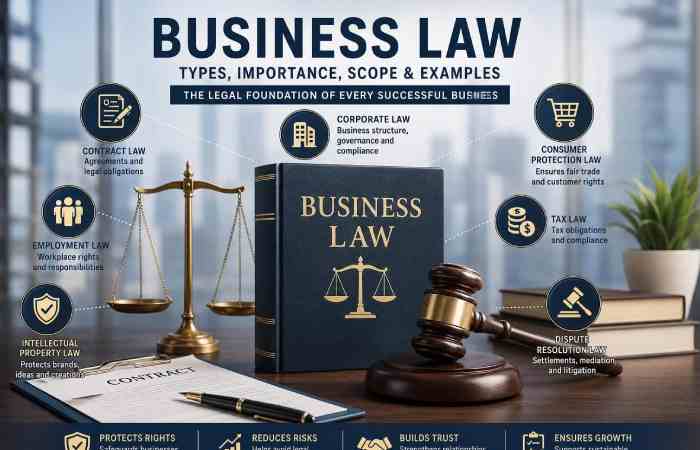
Importance of Business Legal Trends
Laws rarely operate separately from business strategy. A new privacy requirement can affect a company’s website. A change in employment rules can affect hiring. An AI regulation can influence which software a company is allowed to use.
The legal environment is also becoming increasingly international. Even though a company operates from one country, its activities will create legal implications for that company when it engages in business with other companies in other countries.
It is important for companies to follow legal changes rather than relying on old policies that may not apply forever.
Major Business Legal Trends
1. AI Governance is Becoming a Corporate Responsibility
AI is one of the major legal trends impacting corporations.
Many companies are using AI in different ways and I notice AI helps with customer services, marketing, hiring, contract evaluation, financial analysis, fraud detection and improving business processes. I also see that people are increasingly worried about how AI is being used. Today legal conversations about AI focus, on transparency, accountability, privacy, discrimination, intellectual property and automated decision making. In the United States rules have also expanded to cover how AI is used in employment, finance, housing and healthcare.
Why This Matters
Businesses cannot simply purchase an AI tool and assume the technology provider carries every responsibility.
2. Data Privacy Is Becoming More Complex
Data privacy continues to be a major legal issue.
Information about individuals is gathered by companies via websites, mobile apps, payments, customer accounts, marketing systems, and employee systems.
At the same time, there is a difference between privacy regulations in each country or region. International business will have to deal with different sets of privacy regulations. It has recently been noted that the international data environment is becoming more and more fragmented.
What Businesses Should Do
Companies should know:
- What personal information they collect
- Why they collect it
- Where it is stored
- Who can access it
- Which third parties process it
- How long it is retained
- What happens if the information is exposed
A basic data inventory can be a useful starting point.
3. India’s Privacy Framework Is Moving Toward Implementation
For businesses operating in India, data protection is an especially important area to monitor.
India’s digital personal data protection framework is moving from legislation and preparation toward practical implementation. Recent reporting notes that businesses, including smaller companies, are having to adapt their privacy practices as the rules are introduced in phases.
This matters for companies using cloud services, SaaS platforms, customer databases, and AI applications.
Small businesses should not assume that privacy compliance is only a concern for large technology companies.
Business Legal Case Studies
Case Study 1: AI and Privacy Litigation
A recent example involving major technology companies illustrates how AI development can create privacy-related legal exposure.
Lawsuits reportedly filed against firms like Apple, Amazon, Meta, Microsoft, Nvidia, and Samsung in August 2026 related to alleged use of recorded voices of people to train AI systems without obtaining proper consent using the biometric privacy laws of Illinois.
Lesson for Businesses
Before using personal or biometric information to develop or improve AI systems, businesses should understand:
- Whether consent is required
- What privacy laws apply
- How information is being collected
- How the data will be used
- Whether third-party vendors are involved
The lesson applies beyond large technology companies. Smaller companies using customer recordings, images, or other personal information should also understand their responsibilities.
Case Study 2: AI Privacy Issues Faced by Indian Businesses
Indian businesses have been increasingly embracing AI even as they prepare for stricter data privacy rules.
Newly published research draws attention to one specific issue related to MSMEs in that companies could be using cloud technology, SaaS, and AI without realizing how data inputted into these services is handled.
Lesson for Small Businesses
Before employees start using a new AI platform, management should establish basic rules.
For example, employees could be instructed not to enter:
- Customer personal information
- Passwords
- Confidential contracts
- Private financial information
- Sensitive employee records
A simple AI usage policy can reduce unnecessary exposure.
Case Study 3: AI Agents and Business Accountability
AI agents create another emerging legal issue because they can do more than provide suggestions.
They may execute tasks, make decisions, interact with systems, or initiate business actions.
A recent discussion of AI agents in Indian business environments highlighted a central question: if an AI agent makes an incorrect decision, responsibility does not simply disappear because software made the decision. Organizations deploying these systems remain responsible for governance and oversight.
Lesson for Businesses
Companies using autonomous AI should consider:
- Which actions an AI agent can perform
- What permissions it has
- Which employee oversees it
- Whether decisions are logged
- When human approval is required
- How mistakes can be reversed
AI should have clearly defined boundaries.
Businesses’ Strategies towards Ensuring Future Compliances
Legal compliance cannot be viewed as an annual process.
It should be done continuously.
Identifying the Weak Spots
It is necessary to pay attention to those aspects which could have serious consequences for the company’s finances, reputation, or laws.
Training of Employees
Employees should be aware of practical rules which will affect their activities at work.Revise the Guidelines
Guidelines should be revised where there is a shift in the firm’s technology, workers, consumers, or legal considerations.
Take Professional Help
Where a matter includes significant legal risks or compliance considerations, business organizations should seek help from a relevant legal expert.
Conclusion
The future of business legal management is becoming more closely connected to technology, data, cybersecurity, and responsible business practices.
AI governance, privacy protection, cybersecurity, automated decision-making, employment technology, and regulatory monitoring are likely to remain important areas for companies of all sizes.
The recent case studies also demonstrate an important principle: technology does not remove legal responsibility.
Regular legal reviews, employee training, organized documentation, conducting routine legal audits, staff training, structured document management, privacy protection, contract management, and prudent IT policies will enable businesses to develop a better footing.
At the end of the day, keeping up with the legal aspects of doing business is not just about staying out of trouble but creating a company people can trust.