

What Is Forex Exchange?
Forex exchange, also called foreign exchange or FX, is the process of converting one currency into another. It is one of the largest financial markets in the world where currencies are bought and sold daily.
In simple terms:
- One currency is exchanged for another currency
- The exchange happens at a specific rate called the exchange rate
- The value changes based on demand and supply
For example:
- Converting Indian Rupees (INR) into US Dollars (USD)
- Exchanging Euros (EUR) for Japanese Yen (JPY)
Forex exchange plays a major role in:
- International trade
- Tourism
- Investing
- Global business transactions
Meaning of Forex Exchange
The term “forex” comes from:
- Foreign
- Exchange
It refers to the global system where currencies are traded between countries, businesses, banks, and investors.
Whenever money from one country is converted into another country’s currency, forex exchange takes place.
How Forex Exchange Works
Forex exchange works through currency pairs.
What Are Currency Pairs?
Currencies are traded in pairs because one currency is always exchanged for another.
Examples:
- USD/INR
- EUR/USD
- GBP/JPY
If USD/INR = 85:
- 1 US Dollar = ₹85
This means:
- You need ₹85 to buy 1 US Dollar.
Understanding Exchange Rates
An exchange rate is the value of one currency compared to another currency.
Example
Suppose:
- 1 USD = ₹85
If the rate changes to:
- 1 USD = ₹87
The US Dollar becomes stronger compared to the Indian Rupee.
Exchange rates constantly change because of:
- Demand and supply
- Economic conditions
- Inflation
- Interest rates
- Political stability
Example of Forex Exchange in Real Life
International Travel
Suppose an Indian tourist travels to the United States.
They need:
- US Dollars instead of Indian Rupees
So they exchange:
- INR → USD
This is a forex exchange transaction.
International Business
An Indian company imports products from Europe.
The payment may need to be made in Euros.
So the company exchanges:
- INR → EUR
Forex exchange enables global trade.
Forex Market Explained
The forex market is the global marketplace where currencies are traded. It is decentralized, meaning there is no single physical location controlling it.
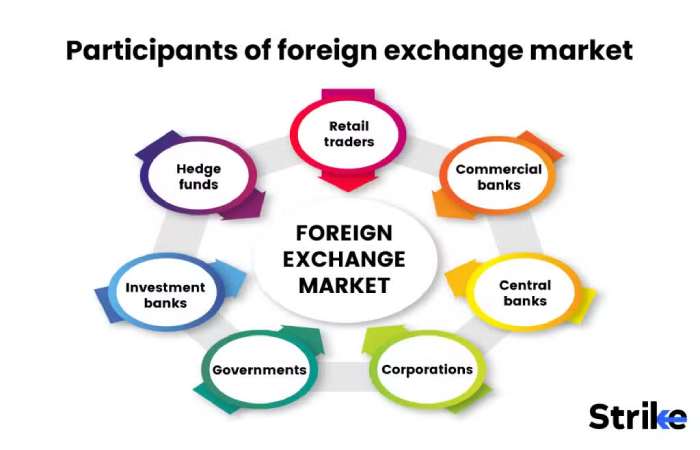
Banks, financial institutions, companies, governments, and traders participate in the market daily.
Features of the Forex Market
Largest Financial Market
Forex is considered the largest and most liquid financial market globally.
Operates 24 Hours
The forex market works 24 hours a day from Monday to Friday because global financial centers operate in different time zones.
High Liquidity
Currencies can be bought and sold quickly because of huge trading volumes.
Decentralized System
Forex trading happens electronically through networks of:
- Banks
- Brokers
- Institutions
There is no central exchange like a stock market.
Types of Forex Exchange Transactions
Spot Market
Currencies are exchanged immediately at current market rates.
Forward Market
Currencies are exchanged at a future date at a predetermined rate.
Futures Market
Currency contracts are traded on exchanges with fixed future settlement dates.
Participants in Forex Exchange
Several groups participate in forex transactions.
Banks
Banks facilitate currency conversion and trading.
Governments and Central Banks
Central banks influence exchange rates through monetary policies.
Businesses
Companies use forex exchange for imports, exports, and international payments.
Investors and Traders
Investors trade currencies to profit from exchange rate fluctuations.
Tourists and Travelers
Travelers exchange money when visiting foreign countries.
Factors Affecting Forex Exchange Rates
Exchange rates change constantly due to multiple economic and political factors.
Interest Rates
Higher interest rates often attract foreign investors and strengthen a currency.
Inflation
Countries with lower inflation usually have stronger currencies.
Political Stability
Stable countries generally attract more foreign investment.
Economic Performance
Strong economies usually support stronger currencies.
Demand and Supply
If demand for a currency increases, its value rises.
Forex Trading vs Forex Exchange
These terms are related but different.
| Feature | Forex Exchange | Forex Trading |
|---|---|---|
| Purpose | Currency conversion | Profit from currency movement |
| Users | Travelers, businesses | Traders and investors |
| Goal | Exchange money | Earn trading profits |
| Example | INR to USD | Buying EUR/USD for profit |
Forex exchange mainly focuses on converting currencies, while forex trading focuses on speculation and profit-making.
Importance of Forex Exchange
Forex exchange is essential for the global economy.
Supports International Trade
Businesses need currency conversion for imports and exports.
Enables Global Travel
Tourists require local currencies when visiting foreign countries.
Helps Foreign Investments
Investors exchange currencies to invest internationally.
Supports Global Financial Systems
International banking and transactions depend on forex exchange.
Advantages of Forex Exchange
Easy International Transactions
Businesses can trade globally through currency conversion.
High Liquidity
Currencies can be exchanged quickly.
Global Accessibility
Forex operates worldwide across multiple financial centers.
Supports Economic Growth
International trade and investments become easier.
Risks Associated with Forex Exchange
Exchange Rate Fluctuations
Currency values can change rapidly.
Political Risks
Government instability may affect currency strength.
Economic Uncertainty
Inflation and recession can weaken currencies.
Market Volatility
Forex markets can become highly volatile during major events.
Fixed vs Floating Exchange Rates
Fixed Exchange Rate
The government fixes the currency value against another currency.
Floating Exchange Rate
Currency value changes according to market demand and supply.
Most modern currencies use floating exchange systems.
Forex Exchange in India
In India, forex exchange is regulated by:
- Reserve Bank of India (RBI)
- Authorized banks and forex dealers
Forex services are commonly used for:
- International travel
- Education abroad
- Import-export businesses
- Overseas investments
Common Forex Exchange Terms
Currency Pair
Two currencies traded together.
Example:
USD/INR
Exchange Rate
The value of one currency against another.
Base Currency
The first currency in a pair.
Example:
USD in USD/INR
Quote Currency
The second currency in a pair.
Example:
INR in USD/INR
Modern Trends in Forex Exchange (2026)
Digital Forex Platforms
Online forex services are becoming more common.
AI-Based Trading Systems
Artificial intelligence is increasingly used in forex analysis and trading.
Faster Global Payments
Technology is improving international money transfers.
Cryptocurrency Influence
Digital currencies are influencing global currency markets.
Key Takeaways
Important Points to Remember
- Forex exchange means converting one currency into another
- Exchange rates determine currency values
- Forex supports international trade, travel, and investment
- The forex market is the largest financial market globally
- Currency values change because of economic and political factors
Final Thoughts
Forex exchange is one of the most important systems in the global economy. Without it, international trade, travel, and global business transactions would become extremely difficult.
Every time currencies are exchanged:
- Businesses complete international payments
- Travelers use foreign currencies
- Investors move money globally
Although the concept may seem complex initially, forex exchange is simply about understanding how currencies are valued and traded across the world.