

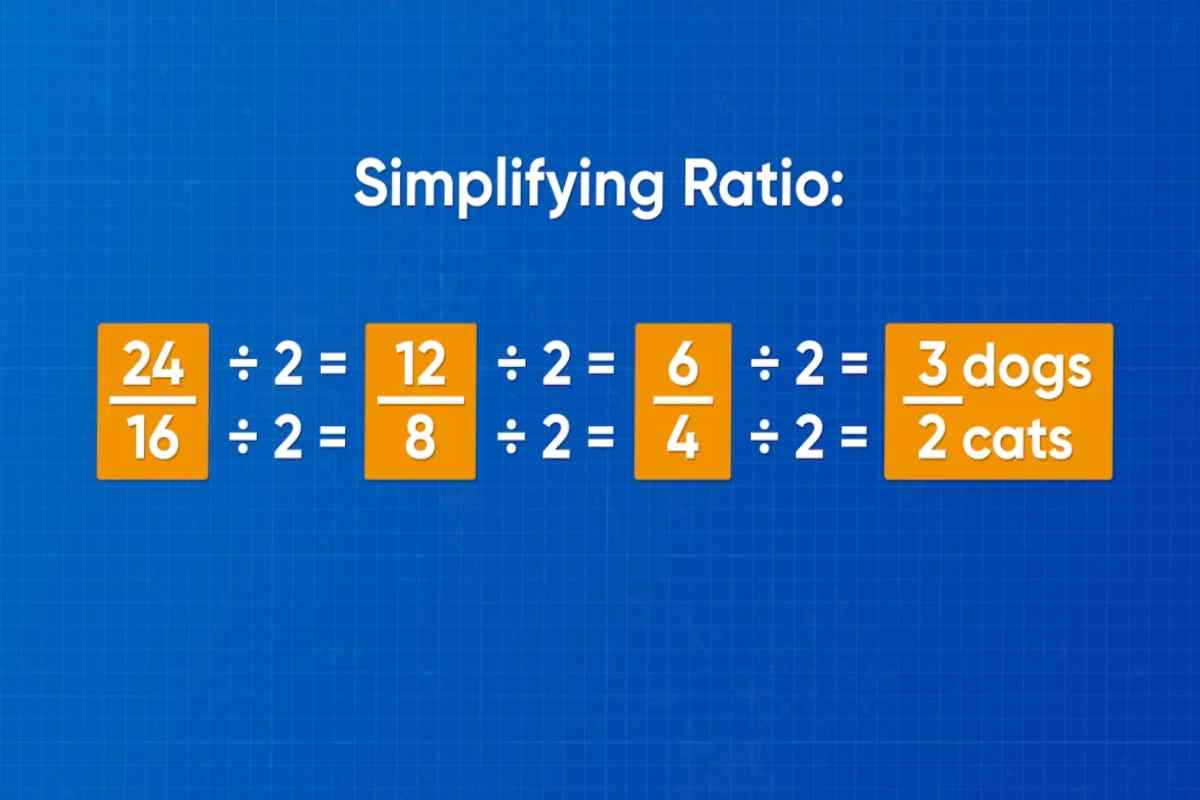
What is Ratio? Find Some Aspect of Ratio.
The definition of ratio can therefore be described as a relationship between two quantities that expresses how many times the first quantity contains the second.
There are three ways of expressing ratios:
Format Example
Colon Format 2:3
Fraction Format 2/3
Word Format 2 to 3
These are different ways of presenting the relationship that exists between two numbers.
Importance of Ratio
Ratio is important in mathematics, business, finances, sciences, and even our daily life because it helps us compare the numbers easily.
Importance of Ratio
Analysis of performance
Decision-making
Understanding large numbers
For instance:
Businesses compare profit and revenue
- Students compare marks and attendance
The ratio of apples to oranges is:
8:4
After simplification:
2:1
This implies that:
2 Apples : 1 Orange
Example 2: Students in a Classroom
In a classroom, there are:
15 Boys
10 Girls
The ratio between boys and girls will be:
15 : 10
Simplified Ratio:
3:2
Example 3: Business Profit
In a business, the company earns:
₹ 50,000 Revenue
₹ 10,000 Profit
Thus, the
Example 3: Business Profit
A company earns:
- ₹50,000 revenue
- ₹10,000 profit
The profit-to-revenue ratio becomes:
10,000:50,000
Simplified:
1:5
This means:
- The company earns ₹1 profit for every ₹5 revenue.
Parts of a Ratio
Every ratio has two parts.
Antecedent
The first number in the ratio.
Example:
In 3:5 → 3 is the antecedent.
Consequent
The second number in the ratio.
Example:
In 3:5 → 5 is the consequent.
Types of Ratios
There are several types of ratios used in mathematics and business.
Simple Ratio
A direct comparison between two quantities.
Example:
4:7
Equivalent Ratio
Different ratios representing the same relationship.
Examples:
- 2:4
- 4:8
- 6:12
All simplify to:
1:2
Compound Ratio
Created by combining two or more ratios.
Example:
- 2:3
- 4:5
Compound ratio:
8:15
Direct Ratio
When one quantity increases, the other also increases.
Example:
- More workers → More production
Inverse Ratio
When one quantity increases, the other decreases.
Example:
- More workers → Less completion time
Ratio vs Fraction
Ratios and fractions look similar but have different meanings.
| Feature | Ratio | Fraction |
|---|---|---|
| Purpose | Comparison | Part of a whole |
| Example | 2:3 | 2/3 |
| Meaning | Relationship between values | Portion of total |
Ratios compare quantities, while fractions represent parts of a whole.
Ratio vs Proportion
A ratio compares quantities.
A proportion shows that two ratios are equal.
Example
2:4 = 4:8
This is a proportion because both ratios represent the same relationship.
Real-Life Applications of Ratios
Financial analysis is only one part of business decision-making; companies may also consider customer protections such as a warranty when evaluating products and services.
Ratios are used in many practical situations.
Cooking and Recipes
Recipes often use ingredient ratios.
Example:
- 2 cups flour : 1 cup sugar
Business and Finance
Companies use ratios to measure:
For businesses developing new products or technologies, legal considerations can also arise, including the need for guidance from a patent attorney when protecting intellectual property.
Financial ratios can also help investors understand the performance and structure of investment funds such as ACFOX.
- Profitability
- Debt
- Efficiency
- Performance
Examples include:
- Profit margin ratio
- Current ratio
- Debt ratio
Maps and Scale Drawings
Maps use ratios to represent distances.
Example:
1:1000
Meaning:
- 1 cm on map = 1000 cm in reality
Sports Statistics
Ratios are used to analyze:
- Win-loss records
- Scoring rates
- Player performance
Education
Teachers use ratios for:
- Attendance comparison
- Marks analysis
- Student performance tracking
Advantages of Ratios
Easy Comparison
Ratios simplify large numbers.
Better Decision-Making
Businesses use ratios for analysis and planning.
Good decision-making also depends on effective resource management, especially when businesses need to balance people, money, time, and other resources.
Useful in Multiple Industries
Ratios are used in:
- Mathematics
- Finance
- Science
- Engineering
- Marketing
Ratio in Mathematics
Ratios are important in:
- Algebra
- Geometry
- Percentages
- Probability
- Statistics
Understanding ratios helps students solve advanced mathematical problems later.
Ratio in Business and Marketing
Businesses rely heavily on ratios.
When analyzing sales and marketing performance, it is also useful to understand what a product is and how its value can be measured in relation to business results.
Marketing Ratios
Companies track:
- Conversion ratios
- Advertising performance ratios
- Customer acquisition ratios
These measurements can help businesses understand how effectively marketing activities are turning customer interest into an actual purchase.
Sales Ratios
Sales teams compare:
- Leads vs conversions
- Revenue vs expenses
Ratios help businesses improve performance and profitability.
Modern Uses of Ratios in 2026
Today, ratios are heavily used in:
- Data analytics
- Artificial intelligence
- Financial forecasting
- Digital marketing
Businesses use ratios to analyze customer behavior, market trends, and operational efficiency.
Modern digital tools such as Search Atlas can also support businesses in analyzing online data, search performance, and customer trends.
Artificial intelligence
Financial forecasting
Digital marketing
Businesses also rely on project and workflow tools to organize data and marketing activities, including options such as a Smart Sheet alternative.
The business employs ratios to evaluate the behaviors of customers, market trends, and efficiency of operations.
Key Takeaways
Important Points to Note
Ratio is a comparison of two values
Ratios are expressed in various formats
Ratios make comparing and analyzing easy
They are commonly used in mathematics, finance, and business
Knowledge of ratios enhances analytical skills
Conclusion
Though ratios appear as a basic math concept, it is one of the most useful tools to know the relationship between numbers.
In the classroom, recipes, business, finance, among others, ratios assist people to:
Compare values
Evaluate performance
Take better decisions
With knowledge of how ratios work, other ideas in math and business will be easy to understand.