

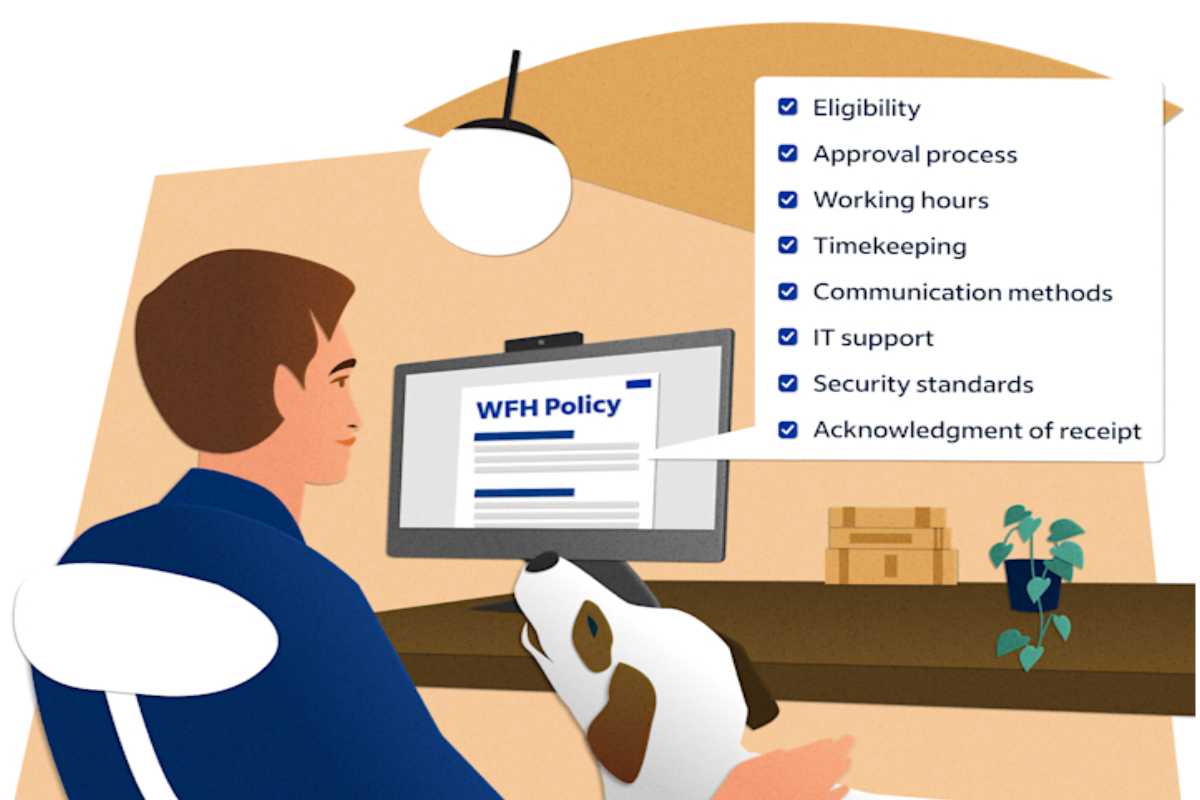
Remote Working Policy: A Guide to Efficient Practice in Modern Companies
Remote-work policy—The practice of remote working has become increasingly popular among many companies. In some cases, employees work remotely in full. In other cases, hybrid practices are used when employees alternate between working from home and in the office.
However, although remote working can provide a lot of benefits, it still presents a challenge for both employers and employees. Without any clear instructions, communication, schedule, productivity, technology, information safety, and availability might become a problem.
A properly formulated remote work policy serves as a guide for employees and their supervisors on how remote working should be performed. Such a policy provides guidelines for efficient practice but doesn’t complicate flexible work in any way.
What is a Remote Work Policy?

The policy may explain:
- Who can work remotely
- When remote work is permitted
- Expected working hours
- Communication requirements
- Performance expectations
- Equipment responsibilities
- Data security
- Meeting arrangements
- Availability
- Leave and attendance
- Health and safety expectations
The policy should take into consideration how the company operates and not just mimic a sample policy document.
Why Is a Remote Work Policy Necessary?
Remote work could be successful when the expectations from the employee are clear. The issue usually occurs when there are no such expectations.
For instance, one manager might expect an immediate response to the message all day long, while another would care about the deadline only. A clear policy could help avoid situations like that.
- Remote work policy could benefit businesses by:
- Setting clear expectations
- Making communication better
- Support consistent management
- Protect company information
- Clarify employee responsibilities
- Reduce misunderstandings
- Create a more organized remote workplace
The policy should provide structure while still allowing employees to work effectively.
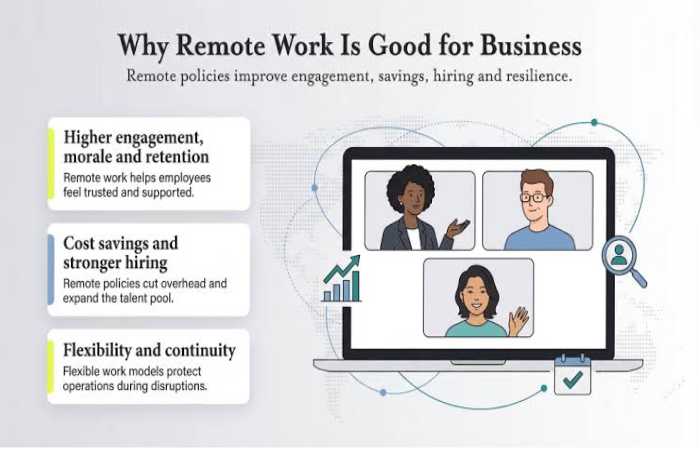
Decide Who Can Work Remotely
Not every role can be performed remotely.
Prior to implementing telecommuting, companies need to analyze the nature of the job. There may be certain jobs which mandate the physical presence of the employees due to the usage of machinery, dealing with customers, facility management, and so on.
For the positions where telecommuting is an option, the organization can outline the conditions for telecommuting.
These might consider:
- Job responsibilities
- Employee performance
- Ability to work independently
- Security requirements
- Business needs
- Appropriate equipment availability
Eligibility criteria need to be made clear to employees so that they know the process behind such decisions.
Define Work Hours and Availability
One of the key elements of a telecommuting policy is defining working hours for employees.
The policy should clarify:
- Standard working hours
- Required availability
- Breaks
- Meeting expectations
- Time-zone considerations
- Procedures for reporting absence
- Being remote doesn’t mean being “on” all day long.
Defining specific working hours can assist employees in establishing their boundaries while providing managers with an idea about the availability of the team members.
Define Communication Rules
It may become harder to communicate when the employees work remotely. Therefore, a remote work policy should define what channels employees should utilize and when.
For instance:
- Email for formal communication
- Messaging platforms for quick questions
- Video meetings for discussions that require real-time collaboration
- Project management systems for task updates
Equip Employees with Appropriate Tools
Tools must be provided for the employee to complete his/her job.
It will vary depending on the job; thus, the organization may supply:
- Laptop or computer
- Monitor
- Keyboard and mouse
- Headset
- Required software
- Security tools
- Other role-specific equipment
This policy needs to clarify who is accountable for the company’s equipment and what should be done if it does not work.
Meetings and Collaboration
The remote work policy can specify the following:
- Joining meetings on time
- Checking calendars regularly
- Participating when required
- Using appropriate communication channels
- Giving advance notice when unable to attend
Not every discussion needs to be a video meeting. Written communication and shared project tools can sometimes be more efficient.
The goal should be effective collaboration rather than filling the workday with meetings.
Create Clear Leave and Attendance Procedures
Even though teleworking means working at home, it doesn’t change the regular duties relating to absence and taking leaves.
Employees must use the same standard way of applying for a leave or absence unless the company has some special guidelines for teleworkers.
The policy should explain:
- How leave is requested
- Who approves it
- How unexpected absence should be reported
- What to do when an employee is unavailable during working hours
Proper procedures can help to reduce possible misunderstanding between employees and management.
Create a Professional Workplace

There must be a proper place for the completion of work by employees.
This depends on the kind of work to be done, and it may require a quiet place, internet connection, appropriate equipment, and confidentiality.
However, employers should also be realistic enough to know that not all employees have an ideal working environment at their homes.
What really matters is whether the work can be done effectively or not. Work-life Balance
- One of the benefits of remote work is the flexibility; however, this may create the problem of mixing work and personal life.
- Managers must not create any expectations regarding the fact that employees will answer work messages after their working hours if it is not required by the job.
- Employees need to take some breaks and use vacation days.
- It is important to understand that productive work in the remote workplace requires sustainable work.
- Remote Work Policy Checklist
Use this checklist when creating remote work policy:
☐ Define remote and hybrid work arrangements
- ☐ Identify eligible roles
- ☐ Establish working hours
- ☐ Define availability expectations
- ☐ Explain communication procedures
- ☐ Set performance expectations
- ☐ Clarify equipment responsibilities
- ☐ Explain data security requirements
- ☐ Establish meeting guidelines
- ☐ Explain leave and attendance procedures
- ☐ Address workplace conduct
- ☐ Explain how remote work arrangements are reviewed
- ☐ Provide a process for raising concerns
- ☐ Review the policy regularly
Conclusion
Remote work policy must be clear without stripping away the flexibility associated with the concept. It needs to clarify on how one should be accessible, how he or she will interact, what is expected of him or her, and how company assets will be used.
Such policy needs to be practical and clear. It admits the fact that working remotely involves elements such as trust, accountability, communication, and boundaries.
With more companies adopting remote or hybrid styles of working, there is a need to evaluate the remote work policy periodically to ensure that it benefits both employees and management.
It is important to recognize the fact that remote work policy is not a list of policies but rather a framework that enables efficient working, communication, and accountability regardless of geographical locations.