


Work Breakdown Structure (WBS): Practical Guide with Real Examples & Use Cases (2026)
If you’ve ever managed a project—whether it’s building a website, launching a product, or even planning a wedding—you’ve probably felt overwhelmed at some point.
That’s where a Work Breakdown Structure (WBS) quietly becomes one of the most powerful tools in project management.
Not because it’s complicated.
But because it turns chaos into clarity.
Instead of looking at a project as one big task, WBS helps you break it down into smaller, manageable pieces—so nothing gets missed, delayed, or misunderstood.
In this guide, I’ll explain WBS in a practical, real-world way—no textbook definitions—so you can actually use it in your projects.
What Is a Work Breakdown Structure (Without the Jargon)
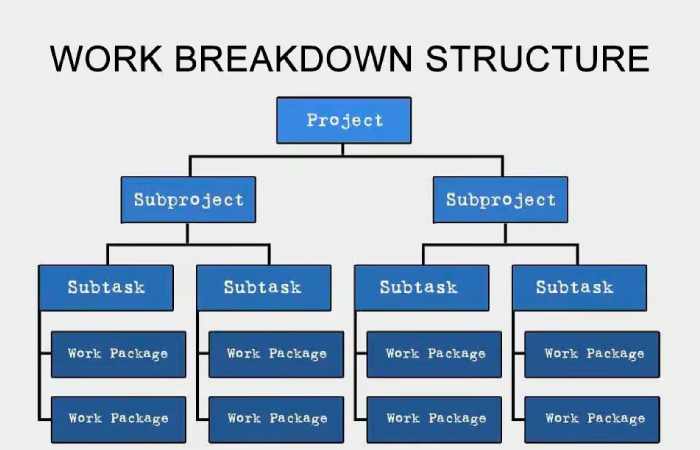
At its core, a Work Breakdown Structure is a way to divide a large project into smaller, clearly defined parts.
Instead of saying:
“We need to build a website”
You break it into:
- Design
- Development
- Content
- Testing
And then break those down even further.
This creates a hierarchical structure where each level adds more detail until the work becomes easy to manage.
Why WBS Is More Important Than Most People Realize
Here’s the truth:
Most project failures don’t happen because of bad execution—they happen because of poor planning.
WBS solves that.
What It Actually Fixes
- Unclear scope
- Missed tasks
- Budget overruns
- Team confusion
By breaking work into smaller components, teams can:
- Estimate time accurately
- Assign responsibilities clearly
- Track progress easily
Real-Life Example (Simple but Powerful)
Let’s say you’re launching an eCommerce store.
Without WBS
- Build website
- Add products
- Launch
Sounds simple—but leads to confusion.
With WBS
Level 1: Project – eCommerce Launch
Level 2:
- Website Development
- Product Setup
- Marketing
Level 3 (Example: Website Development):
- UI Design
- Backend Setup
- Payment Integration
- Testing
Now every task is visible and manageable.
How WBS Works in Practice
A Work Breakdown Structure follows a top-down approach.
You start with the final goal, then break it down step by step into smaller units.
The 3 Key Levels
1. Project Goal
The final outcome (e.g., “Build Mobile App”)
2. Major Deliverables
Big sections of work:
- Design
- Development
- Testing
3. Work Packages
Small tasks that can be assigned and completed.
These are the most important part because they are:
- Measurable
- Trackable
- Easy to assign
The “100% Rule” (The Secret Behind Good WBS)
One concept most beginners miss is the 100% rule.
It means:
Your WBS must include 100% of the work required—nothing more, nothing less
If something is missing, your project will suffer.
If something extra is added, you waste time and budget.
Types of Work Breakdown Structures
Not all projects are the same, so WBS can be created in different ways.
1. Deliverable-Based WBS
Organized by outcomes.
Example:
- Website
- Mobile App
- Marketing Campaign
Best for complex or technical projects.
2. Phase-Based WBS
Organized by stages.
Example:
- Planning
- Execution
- Testing
Best for linear projects.
Case Study: Why a Company Needed WBS
Situation
A startup was building a SaaS product.
Problems:
- Tasks were unclear
- Deadlines kept shifting
- Teams blamed each other
What They Did
They created a WBS:
- Broke product into modules
- Assigned owners
- Defined timelines
Results
- 40% faster delivery
- Clear accountability
- Fewer delays
The difference wasn’t effort—it was structure.
Benefits of Using WBS (Real Impact)
1. Better Planning
You know exactly what needs to be done.
2. Accurate Cost Estimation
Each task can be budgeted properly.
3. Clear Responsibility
Every task has an owner.
4. Improved Team Coordination
Everyone understands their role.
5. Reduced Risk
No hidden or forgotten tasks.
Common Mistakes People Make
Even experienced teams get WBS wrong.
Mistake 1: Breaking Tasks Too Much
Too much detail creates confusion.
Mistake 2: Not Breaking Enough
Large tasks become unmanageable.
Mistake 3: Mixing Tasks and Outcomes
WBS should focus on deliverables, not actions.
Mistake 4: Ignoring Dependencies
Tasks must connect logically.
How to Create a WBS (Step-by-Step)
Step 1: Define the Goal
Be clear about the final outcome.
Step 2: Identify Major Deliverables
Break the project into main parts.
Step 3: Break Into Smaller Tasks
Keep dividing until tasks are manageable.
Step 4: Assign Ownership
Every task must have a responsible person.
Step 5: Review and Refine
Make sure nothing is missing.
Tools You Can Use for WBS
You don’t need complex software.
Simple Tools
- Excel
- Google Sheets
- Whiteboards
Advanced Tools
- Project management software
- Gantt chart tools
- Collaboration platforms
WBS vs Task List (Important Difference)
| Feature | WBS | Task List |
|---|---|---|
| Structure | Hierarchical | Flat |
| Focus | Deliverables | Activities |
| Clarity | High | Medium |
A task list tells you what to do
WBS shows how everything connects
When Should You Use WBS?
Use it when:
- Project is complex
- Multiple teams involved
- Deadlines are tight
- Budget matters
When You Might Not Need It
- Small personal tasks
- Simple projects
- One-person work
Future of WBS in 2026
WBS is evolving with modern tools.
Trends
- AI-assisted project planning
- Automated task breakdown
- Integration with real-time dashboards
But the core idea remains the same:
Break work into manageable parts
What are the Levels of a Work Breakdown Structure (WBS)?
A WBS in project management supports large and complex projects and divides the project’s scope into more manageable parts to facilitate planning, planning, and delivery. Project task and deliverable levels create to support project planning, execution, Marketing campaign planning, and monitoring. There are four main stages of a WBS, described below:
The upper level: the title of the project or the final delivery.
Control account: The main phases and deliverables of the project.
Work Packages: The group of tasks that lead to the controlling account level.
Activities: the tasks required to complete the work package.
These levels find in all the different types of work breakdown structures.
What are the Types of Work Breakdown Structure (WBS)?
There are two main types of WBS: delivery-based and phase-based. A deliverable-based WBS identifies the deliverables and scope of the project. At the same time, the phase-based WBS shows the final delivery at the top, and the lower level offers the five phases of a project (initiation, planning, execution, control, and closing).
There are also insufficient rare types of work breakdown structures:
- A verb-oriented WBS defines deliverables in terms of actions.
- A name-oriented WBS defines work in terms of components (this also call a product breakdown structure).
- And also, phased WBS divides the project into phases for long-term projects.
A work breakdown structure is a very flexible tool. It can take the form of a simple numbered list (also known as an overview), a basic tree chart, or smooth a Gantt chart. When a Gantt chart is share as a greater project management tool, the WBS can shift to planning, assigning, tracking, and tracking your team’s progress.
Key Takeaways
- A Work Breakdown Structure helps divide projects into smaller tasks
- It improves planning, execution, and tracking
- It follows a hierarchical, top-down approach
- It ensures complete project coverage (100% rule)
- It is essential for complex projects
Final Thoughts
A Work Breakdown Structure might sound like a technical concept, but in reality, it’s just common sense applied correctly.
Every big goal becomes easier when you break it down.
That’s exactly what WBS does.
It doesn’t make your team work harder.
It makes your work clearer.
And in project management, clarity is everything.