


Table of Contents
How Does the Spot Market Work in Forex Trading?
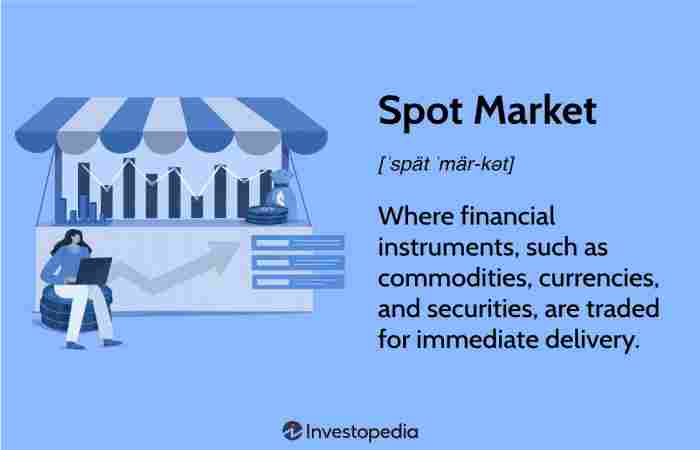
If you’ve ever heard traders talk about “spot prices” or “spot trades” in forex, you might have wondered what exactly they mean. The spot market is the backbone of the foreign exchange (forex) world — it’s where currencies are traded instantly, at current prices.
In this guide, I’ll explain how the spot market works in forex trading, why it’s so important, and what makes it different from other forex markets like forwards or futures.
What Is the Spot Market in Forex Trading?
The Basics
The spot market in forex is where traders buy and sell currencies at their current exchange rate, known as the spot rate, typically through currency spot trading (a.k.a FX trading) brokers that provide access to real-time market prices. The transaction happens “on the spot” — meaning right away — though settlement usually takes two business days for most currency pairs.
For example, if you buy EUR/USD at 1.0750, you’re agreeing to exchange euros for dollars at that exact rate, based on real-time market conditions.
Why It’s Called the “Spot” Market
The term spot refers to the immediacy of the transaction. You’re not betting on what the exchange rate will be next week or next month — you’re trading based on the price right now.
How the Spot Market Works
Let’s break down the process step-by-step so you can see how the spot market operates in practice.
Step 1: Understanding the Spot Rate
The spot rate is the real-time price of one currency against another. It fluctuates every second due to supply and demand, geopolitical events, and economic data releases.
For example:
-
If EUR/USD = 1.0750, that means 1 Euro = 1.0750 US Dollars.
-
If USD/JPY = 151.20, then 1 US Dollar = 151.20 Japanese Yen.
These rates are determined by millions of trades happening globally through banks, institutions, and retail traders.
Step 2: Executing a Spot Trade
When you enter a trade in the spot market, you’re either:
-
Buying (going long) a currency pair, expecting its value to rise.
-
Selling (going short) a currency pair, expecting its value to fall.
For instance:
-
If you think the Euro will strengthen against the Dollar, you buy EUR/USD.
-
If you think the Dollar will strengthen, you sell EUR/USD.
The execution is instant — which is why it’s so popular among short-term traders.
Step 3: Settlement Process
Though trades happen instantly, the settlement — meaning the actual exchange of currencies — typically happens two business days later (T+2).
However, in retail forex trading (through brokers), you don’t actually receive physical currencies. Instead, your account balance reflects profit or loss in your base currency.
Example:
You buy 1 lot (100,000 units) of EUR/USD at 1.0750 and sell it later at 1.0800.
Your profit = (1.0800 – 1.0750) × 100,000 = $500.
Who Participates in the Spot Market?
The forex spot market is the largest financial market in the world, with daily trading volumes exceeding $7 trillion. It involves various players, each with different goals.
1. Central Banks
They manage currency reserves, stabilize the economy, and influence exchange rates.
2. Commercial Banks
They execute massive transactions on behalf of corporations and clients.
3. Hedge Funds and Investment Firms
They trade to profit from market movements and hedge portfolio risks.
4. Corporations
Multinational companies use the spot market to convert foreign income or pay overseas suppliers.
5. Retail Traders
That’s where most of us fit in — individuals trading through forex brokers to make profits from short-term currency fluctuations.
Advantages of Trading in the Spot Market
The forex spot market has several benefits that attract both beginners and professionals alike.
1. Immediate Execution
You can open and close positions almost instantly — no waiting for future dates.
2. High Liquidity
The forex market runs 24 hours a day, five days a week, with trillions traded daily. This ensures smooth order execution and tight spreads.
3. Transparent Pricing
Spot prices are determined by real-time supply and demand, making it easy to track fair market value.
4. Low Cost of Entry
You can start trading with small amounts, especially through leveraged trading accounts offered by brokers.
5. Flexible Trading Opportunities
Whether you’re a scalper, day trader, or swing trader, the spot market provides opportunities for all timeframes.
Spot Market vs. Forward and Futures Market
To understand how unique the spot market is, it helps to compare it with other forex markets.
| Feature | Spot Market | Forward Market | Futures Market |
|---|---|---|---|
| Settlement Time | Immediate (T+2) | Future date (custom) | Fixed future date |
| Contract Type | On-the-spot trade | Private agreement | Standardized contract |
| Flexibility | Highly flexible | Customizable | Fixed terms |
| Participants | Retail & institutions | Corporates & banks | Investors & traders |
| Risk Exposure | Market risk | Counterparty risk | Margin & market risk |
Spot vs. Forward Market
-
The spot market is for immediate trades.
-
The forward market locks in a rate for a future date, helping businesses manage currency risk.
Spot vs. Futures Market
-
The futures market uses standardized contracts traded on exchanges.
-
The spot market is decentralized (OTC), meaning trades occur directly between parties or via brokers.
How Are Spot Prices Determined?
The spot price isn’t random — it’s driven by global economic and financial forces.
1. Supply and Demand
When demand for a currency rises (say, USD), its value increases relative to others.
2. Economic Indicators
Interest rates, inflation, GDP growth, and employment data all affect currency strength.
3. Political Stability
Currencies from politically stable countries are generally stronger and safer investments.
4. Market Sentiment
News, investor confidence, and global events can quickly move spot prices up or down.
5. Central Bank Policies
Central banks influence spot prices through interest rate changes and interventions.
How Traders Use the Spot Market
1. Short-Term Speculation
Traders buy and sell currency pairs within hours or days, aiming to profit from price movements.
2. Hedging
Companies that deal in multiple currencies use spot trades to hedge against sudden exchange rate changes.
3. Arbitrage
Professional traders exploit small price differences between forex markets to make risk-free profits.
4. Carry Trades
Some traders borrow in a low-interest currency and invest in a high-interest one — earning profit from interest rate differentials.
Key Factors to Consider Before Trading the Spot Market
Before diving in, keep these points in mind to protect your investment and improve your strategy.
1. Leverage Can Be Risky
Leverage amplifies both profits and losses. Always use it wisely.
2. Understand Spreads and Fees
Even small spreads can affect profits, especially if you trade frequently.
3. Use Technical and Fundamental Analysis
Combine chart patterns (technical) with economic data (fundamental) for better decision-making.
4. Choose a Reliable Broker
Select brokers regulated by authorities like FCA, ASIC, or CySEC to ensure fair trading conditions.
5. Manage Emotions
Don’t let greed or fear dictate your trades — follow a plan and stick to it.
Example of a Spot Forex Trade
Let’s look at a quick real-world-style example:
You believe the British Pound (GBP) will rise against the US Dollar (USD).
-
You buy GBP/USD at 1.2500 for one standard lot (100,000 GBP).
-
Later, the rate moves to 1.2550.
-
You close the trade and make a profit of 50 pips.
Profit = (1.2550 – 1.2500) × 100,000 = $500.
That’s a classic spot trade — quick, direct, and based on real-time price action.
Pros and Cons of the Spot Forex Market
Pros
-
Instant transactions
-
High liquidity and transparency
-
Global access 24/5
-
Lower entry costs
Cons
-
Highly volatile
-
Requires constant monitoring
-
Leverage risk
-
No guaranteed returns
Final Thoughts
So, how does the spot market work in forex trading? In short — it’s where currencies are exchanged instantly at the current market rate, allowing traders and institutions to react quickly to global economic changes.
It’s fast, transparent, and highly liquid — which is why most forex trades happen in the spot market. Whether you’re trading for profit, hedging business risk, or simply learning the ropes, understanding the spot market is the first step to mastering forex.
Remember: success in forex isn’t just about timing the market — it’s about discipline, knowledge, and risk control.