


Go-To-Market Strategy: Practical Guide with Steps, Examples & Real Business Use (2026)
Launching a product or service is not just about building something great. Many businesses fail not because their product is bad—but because they don’t know how to bring it to the market effectively.
That’s where a go-to-market strategy becomes critical.
It acts as the bridge between your product and your customers. Without it, even the best ideas struggle to gain traction.
This guide explains go-to-market strategy in a practical, real-world way—how it works, why it matters, and how you can build one that actually delivers results.
What Is a Go-To-Market Strategy (Simple Explanation)
A go-to-market strategy (GTM) is a structured plan that defines how a business will deliver its product or service to customers and gain a competitive advantage.
In simple terms, it answers:
- Who is your target customer?
- What problem are you solving?
- How will you reach customers?
- How will you sell and position your product?
It’s not just marketing—it’s a complete approach to entering and succeeding in a market.
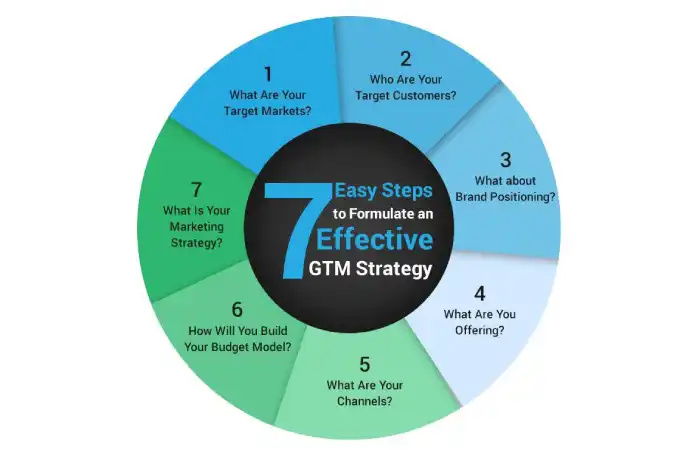
Why Go-To-Market Strategy Matters
Many businesses focus heavily on product development but ignore market entry. That’s a costly mistake.
A strong go-to-market strategy helps you:
- Reach the right audience
- Avoid wasted marketing spend
- Position your product correctly
- Accelerate revenue growth
Without it, businesses often:
- Target the wrong customers
- Choose ineffective channels
- Struggle to gain traction
How a Go-To-Market Strategy Works in Real Life
Let’s simplify it with a practical example.
Scenario: SaaS Product Launch
A company builds a project management tool.
Without a GTM strategy:
- They promote it randomly
- Target everyone
- Spend heavily on ads
Result: low conversions
With a GTM strategy:
- Target small businesses
- Focus on productivity pain points
- Use content marketing and demos
- Offer free trials
Result: higher adoption and growth
Key Components of a Go-To-Market Strategy
To build a successful GTM plan, you need to focus on core elements.
1. Target Market
You must clearly define your audience.
This includes:
- Industry
- Location
- Customer behavior
- Buying potential
Choosing the right target market is critical because all marketing efforts are built around it.
2. Value Proposition
This explains why customers should choose your product.
It answers:
- What problem do you solve?
- Why are you better than competitors?
3. Pricing Strategy
Pricing impacts:
- Customer perception
- Profit margins
- Market positioning
Example:
- Subscription pricing vs one-time payment
4. Distribution Channels
How will customers access your product?
Options include:
- Online platforms
- Direct sales
- Retail or partners
5. Marketing and Promotion
This includes:
- Advertising
- Content marketing
- Social media
- Email campaigns
6. Sales Strategy
Defines how you convert leads into customers.
Examples:
- Inside sales
- Direct sales
- Self-service (online purchase)
Step-by-Step Process to Build a GTM Strategy
Step 1: Identify Your Ideal Customer
Focus on a specific audience instead of targeting everyone.
Step 2: Understand Customer Pain Points
What problem are you solving?
Step 3: Define Your Unique Value
Explain clearly why your solution stands out.
Step 4: Choose the Right Channels
Select platforms where your audience is active.
Step 5: Create a Sales Plan
Decide how you will convert leads into paying customers.
Step 6: Test and Optimize
Monitor performance and adjust strategy as needed.
Real Case Study: Successful GTM Execution
Situation
A startup launched a new software product but struggled with adoption.
Problems:
- No clear audience
- Weak messaging
- Poor channel selection
What They Did
- Narrowed target to small businesses
- Focused messaging on cost savings
- Used content marketing and demos
Results
- Increased sign-ups
- Improved conversions
- Faster revenue growth
The product didn’t change—only the strategy did.
Types of Go-To-Market Strategies
Different businesses use different approaches depending on their model.
1. Product-Led Strategy
- Focus on product experience
- Free trials or freemium model
2. Sales-Led Strategy
- Heavy reliance on sales teams
- Used in B2B businesses
3. Marketing-Led Strategy
- Driven by campaigns and brand awareness
- Common in consumer products
Go-To-Market Strategy vs Marketing Strategy
These are often confused.
| Feature | Go-To-Market Strategy | Marketing Strategy |
|---|---|---|
| Focus | Product launch and entry | Ongoing promotion |
| Scope | Broader (sales + marketing) | Marketing activities only |
| Purpose | Enter and win in market | Build brand and demand |
Marketing strategy is part of GTM, not the whole thing.
Benefits of a Strong GTM Strategy
1. Faster Market Entry
You launch with clarity and direction.
2. Better Customer Targeting
You reach people who are more likely to buy.
3. Higher Conversion Rates
Clear messaging improves results.
4. Reduced Risk
You avoid costly trial-and-error mistakes.
5. Competitive Advantage
You position your product effectively in the market.
Common Mistakes to Avoid
Targeting Everyone
Trying to reach everyone leads to weak positioning.
Ignoring Customer Needs
Products fail when they don’t solve real problems.
Poor Channel Selection
Using the wrong platforms wastes resources.
Weak Messaging
If customers don’t understand your value, they won’t buy.
When You Need a Go-To-Market Strategy
You need a GTM strategy when:
- Launching a new product
- Entering a new market
- Rebranding or repositioning
- Expanding your business
Future Trends in GTM Strategy (2026)
Data-Driven Decision Making
Companies rely more on analytics and insights.
Personalization
Targeted messaging based on customer behavior.
AI Integration
Automation in marketing and sales processes.
Omnichannel Approach
Combining multiple platforms for better reach.
Key Takeaways
- A go-to-market strategy defines how you bring a product to market
- It includes customers, pricing, channels, and sales
- It helps businesses launch effectively and grow faster
- It reduces risk and improves success rates
- It is essential for any product or service launch
Final Thoughts
A go-to-market strategy is not just a plan—it’s a system that connects your product to the right customers in the right way.
Many businesses focus on building great products.
But success depends on how well you bring those products to market.
When done right, a strong strategy doesn’t just support your business—it drives its growth.