


Everything about Account-Based Marketing: A Comprehensive Guide to Targeting Premium B2B Accounts
Account-Based Marketing (ABM) is a specialized B2B marketing technique that involves targeting particular companies rather than reaching out to a broad audience with the same content. In contrast to lead generation and filtration, businesses will identify premium accounts first and develop specialized marketing and sales campaigns aimed at them.
It works great for high-value product or service providers where the decision is made not by one person but by several and where the sales cycle takes longer. ABM involves combining marketing and sales efforts in order to concentrate time, budget, and resources on highly promising accounts.

What Is Account-Based Marketing?
Account-Based Marketing is a strategy in which a business considers certain organizations as separate markets. Marketing content, advertising, sales communication, and outreach are developed considering the problems and challenges, the industry and particular decision makers from those accounts.
For instance, a company that offers an enterprise-level security software will find 50 large organizations that have all the characteristics of ideal customers. Instead of running the same campaign to a thousand other companies, marketing specialists will develop a special content for those 50 accounts while the sales team will
The account-based marketing model focuses not only on lead generation but also interaction with relevant companies and making money through that interaction.
How Does Account-Based Marketing Work?
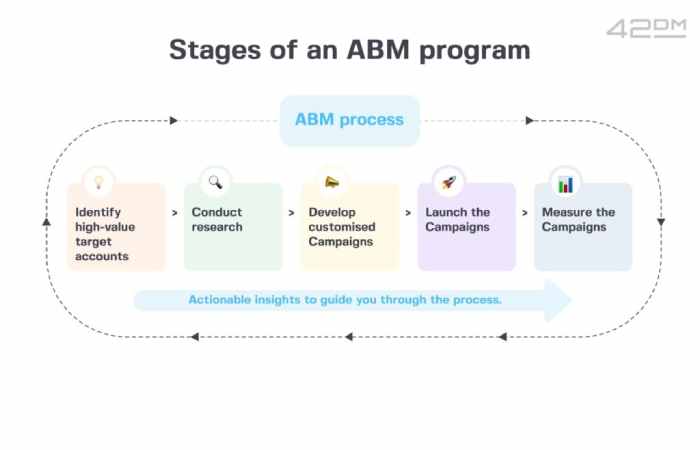
A good ABM marketing strategy normally has the following steps.
1. Identifying Target Accounts
This step involves selecting accounts to go after.
Companies may consider the following criteria:
- Company size
- Industry
- Revenue potential
- Location
- Existing technology
- Business challenges
- Buying potential
- Compatibility with the offerings of the business
An ICP can be very useful for marketing and sales teams to know which accounts should get preference.
- Research the Account
After selecting target companies, teams need to understand them properly.
Areas for research may include objectives, developments, issues within the industry, competition, possible solutions, and purchase considerations.
Identifying the decision-makers is just as important. Areas for research may include objectives, developments, issues within the industry, competition, possible solutions, and purchase considerations.
Identifying the decision-makers is just as important.In bigger B2B companies, there might be more than one person influencing a decision rather than just one person.
- Create Personalized Content
Personalization is a key part of Account-Based Marketing.
Rather than providing generic materials, companies can produce personalized materials in order to deal with certain pain points of a specific account or industry.
Examples include:
- Personalized emails
- Industry-specific guides
- Customized case studies
- Targeted landing pages
- Account-specific presentations
- Personalized product demonstrations
- Relevant webinars
This involves demonstrating to the prospect that the business understands their problem rather than just selling products.
4. Aligning Sales and Marketing
ABM is effective when the marketing and sales teams operate from the same target accounts and objectives.
Marketing could be responsible for creating awareness and engaging potential leads while the sales team can follow up on the contacts.
It would be wise for the two departments to understand which accounts are active, what content they have been engaging with, and at what stage of the buyer’s journey they are.
This alignment can help create consistency for the prospect.
Types of Account-Based Marketing
Depending on the organization’s ability, there are various forms of ABM that an organization can utilize.
One-to-One ABM
This is the most customized approach. Marketing and sales create a detailed strategy for an individual high-value account.
It can work well when a single customer could generate substantial revenue.
One-to-Few ABM
In this case, companies focus on a small number of similar accounts. These companies may belong to the same industry or face similar problems.
Content can be customized for this small number of accounts without limiting the scalability of the campaign.
One-to-Many ABM
This method focuses on a greater number of accounts with the help of technology, automation, and personalized campaigns.
It allows for better scalability while keeping a good focus compared to traditional marketing.
Account-Based Marketing Metrics
Measurement of ABM needs more than just lead volume.
Important metrics can include:
- Target account engagement
- Number of engaged stakeholders
- Account penetration
- Meetings with target accounts
- Opportunities created
- Pipeline generated
- Deal velocity
- Win rate
- Average contract value
- Revenue from target accounts
- Customer retention
Engagement is especially valuable since the account may engage with more than one piece of content before turning into a potential client. Tracking engagement within the buying team gives insight into account development.
Account-Based Marketing Errors to Avoid
First, the error is the wrong choice of target accounts without the criteria of selection. If the list does not fit the business, then even personalization will not help.
The next error is viewing ABM solely as a marketing practice while ignoring sales engagement. It is important for sales to be involved since sales teams know account requirements and process well.
Also, businesses should be careful with over-personalizing the message since there must be some value in doing so. Personalization must be relevant and useful.
The last mistake that needs to be mentioned is to track impressions, clicks, and downloads, but not results.
Steps in Formulating an Effective ABM Strategy
It begins with choosing some customers rather than trying to customize everything straight away. Develop your ideal customer persona, select target accounts, research and build your message for key stakeholders. Marketing and Sales teams need to agree on how they will collaborate.
Channels that could be helpful in an ABM strategy could be email, LinkedIn, search, paid media, webinars, events, sales activities and personalization of the website experience.
Review results and use them to refine your account selection, messaging, content and sales collaboration.
Final Thoughts
ABM represents a complete shift in the approach to customer acquisition in B2B businesses. Rather than just trying to generate a lot of leads, it focuses on targeting the right companies that will become valuable customers.
By collaborating between marketing and sales teams and understanding their target accounts to create relevant experiences, ABM becomes a critical component of a larger B2B growth strategy.