

Guide to Compliance and Risk Management for Modern Business
Compliance and Risk Management Guide—Operating any kind of business involves certain number of uncertainties. While everything seems to be running smooth and fine, a business can run into problems regarding regulations, employees, suppliers, clients, finances, technology, or everyday business operations. Sometimes those problems are rather small-scale and easily solvable, but sometimes they disrupt an entire business operation.
And here comes the importance of compliance and risk management.
While compliance means ensuring a business complies with applicable laws, regulations, requirements, contractual obligations and company policy, risk management involves identifying possible hazards and assessing what a business can do to avoid them or minimize the effects of these hazards.
Compliance and risk management are closely interlinked – neglecting compliance creates unnecessary legal risks, whereas lack of risk management leaves a business unprepared for various contingencies.
Fortunately, compliance and risk management do not need to be complicated. A business, even a small one, can set up a system for monitoring compliance obligations, training employees, securing information and preparing for any possible troubles.

What Is Compliance Management?
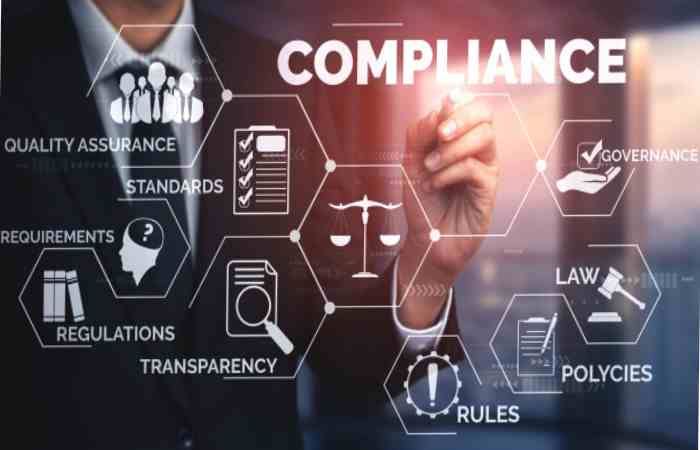
Compliance Management is the mechanism used by the business to comprehend, adhere to, and oversee any obligations associated with the business operations.
This can arise from a number of different sources such as government regulations, contracts, industry standards, licensing, and internal business policy.
For example, the business may be obligated due to legal reasons to provide a safe working environment for employees, while the contract with the customer may impose certain additional obligations regarding service delivery.
Importance of Compliance
The importance of compliance lies in the potential consequences that can follow the non-compliance.
For example, the business can be subject to:
- Monetary sanctions
- Legal disputes
- Loss of licenses
- Contract problems
- Operational disruption
- Customer complaints
- Reputation damage
- Increased regulatory attention
What Is Risk Management?
Risk management is an assessment process that aims at identifying potential dangers for a business entity and managing them accordingly.
All businesses have risks. For instance, manufacturers may have to worry about machine failures, retailers may need to avoid stockouts, and an online business may be particularly worried about security issues. In a professional service business, it may be the risks of contractual or professional liability.
Managing risks means more than trying to eliminate them altogether, which is hardly ever feasible.
It means understanding relevant risks and preparing for them appropriately.
The Connection Between Compliance and Risk Management
Compliance and risk management are different processes but often intersect.
For instance, suppose there is a certain firm whose customer data is stored on its server.
Privacy laws can create certain compliance obligations here. However, the exposure of these data is a business risk in its own right.
The compliance function may concentrate on whether the firm meets certain legal requirements in respect of its data privacy, while the risk management function will be looking at how
The business first needs to understand which rules apply.
Risk Management Identifies Exposure
The firm will then think of the possible outcomes that may arise from the failure to meet those requirements or from any other unforeseen event.
Controls Will Help in Both Aspects
Controlling measures like policies, training, security, documentation, audits, and monitoring can help to reduce exposure risks and also guarantee compliance.
Types of Business Risk
It should be noted that there is no standard set of risks applicable to all firms. Most business organizations can come up with different types of business risks.
Financial Risks
Financial risks refer to the scenarios in which a business may be adversely affected financially.
Some examples of financial risk are:
- Shortages of cash flow
- Delays in receiving payments from customers
- Higher operating expenses
- Fraud
- Unforeseen costs
- Lack of proper planning in finances
- Reliance on only one major client for sales
Operational Risk
Operational risks arise from failures during regular business operations.
A vendor might not provide materials as scheduled. A supplier may fail to deliver materials. Equipment may stop working. An employee may make an important error. A software system may become unavailable.
These events can delay work and affect customers.
Managing Operational Risk
Businesses can reduce operational risk through:
- Documented procedures
- Employee training
- Equipment maintenance
- Backup suppliers
- Quality checks
- Business continuity plans
Appropriate controls will depend on the type of business.
Legal and Regulatory Risks
Legal and regulatory risks emerge any time a firm fails to meet its obligations or gets into legal troubles.
The firm’s obligations might be related to agreements, employment laws, licensing, consumers’ rights, intellectual property, privacy and other industry regulations.
It becomes increasingly important to monitor such obligations as your business grows.
Cybersecurity Risk
As technology has penetrated most businesses, cyber-risk is one of the significant risk areas for any enterprise.
Cyber-risks may include phishing attacks, malware, stolen passwords, breach of confidential information, ransomware, or accidental disclosure of the company’s information.
Small businesses should not take lightly the aspect of handling cybersecurity threats simply because they are small in size since there is no immunity from cyber attackers.
Simple security measures such as using strong passwords, multi-factor authentication, updating software, restricting access, creating backups, and employee training can prove to be very significant here.
Reputational Risk
The reputation of an organization depends on how it handles its dealings with its customers, suppliers, and the society in general. Therefore, reputation management has to be integrated into business as usual and not treated just as
How to Build a Compliance Program
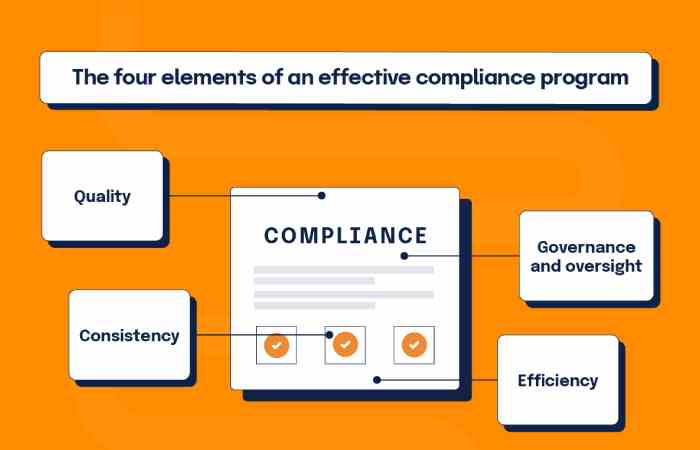
A good compliance program should be practical.
The objective is to recognize obligations which may realistically be controlled.
Step 1: Identifying Applicable Requirements
Consider the requirements to which your business may be legally subject.
Consider:
- Location
- Industry
- Business structure
- Products and services
- Employees
- Customers
- Data collected
- International activities
It should not take for granted that the requirement that is applicable to one firm will apply equally to another firm.
Step 2: Allocation of Duties
For example:
| Compliance Area | Responsible Team |
| Employee policies | HR |
| Financial reporting | Finance |
| Data protection | IT/Management |
| Licenses | Operations |
| Contracts | Management/Legal |
| Workplace safety | Operations/HR |
Organizational structure depends on the organization.
Step 3: Policy Development
Policies must define employee expectations.
Common policies may cover:
- Workplace conduct
- Information security
- Privacy
- Conflicts of interest
- Anti-harassment
- Health and safety
- Expense management
- Use of company technology
The language used for policies should be something that the employees can understand.
Step 4: Training of Employees
If employees do not understand the policy, then the policy becomes meaningless.
The training given must be related to the responsibilities of the individual.
For instance, those dealing with customer data may require training on privacy and security issues while warehouse personnel may need safety training.
Step 5: Monitoring Compliance
Business organizations must ensure that the policies are being implemented.
This can be done by:
- Internal reviews
- Audits
- Record checks
- Employee feedback
- Incident tracking
- Management reports
The purpose is to identify weaknesses and improve processes.
Creating a Risk Management Framework
A risk management framework provides a repeatable way to handle business risks.
Identify the Risk
Ask what could go wrong.
Don’t concentrate only on the obvious problems. Think about suppliers, employees, technology, customers, money, law, and even external factors.
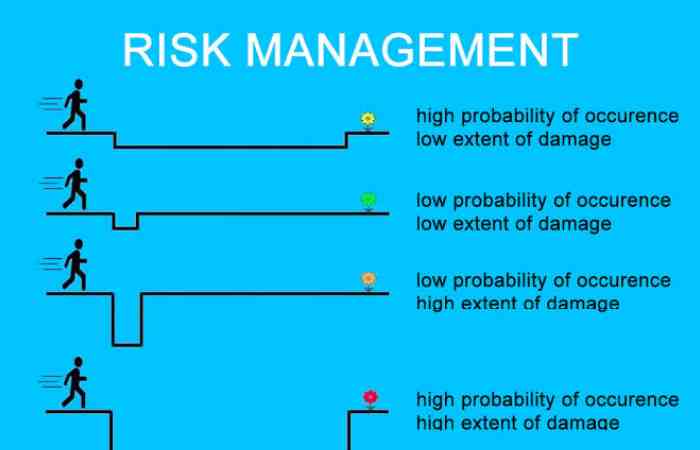
The risk that has a very low probability of occurrence may require attention because of extremely high potential impact.
Prioritize Risks
Not all the risks require the same level of attention.
Businesses can categorize risks according to their importance: low, medium, or high risks.
For example, getting supplies for the office later than expected is not a problem compared to losing access to the production systems.
Compliance Training for Employees
Employees are very important in any organization’s compliance plan.
Even the best policies will be rendered useless if employees are unable to apply them.
Make Training Practical
Training should emphasize practical application.
While it is easy to tell someone that confidential information needs to be safeguarded, give employees real-world examples of the information that they need to keep confidential.
While one could explain how cybersecurity regulations work, also provide an example of how phishing emails can look.
Practical examples tend to be more memorable.
Maintain Training Records
Organizations should maintain appropriate records to demonstrate when required training was completed by whom.
This will assist management to monitor progress and also identify those who require further training.
Managing Third-Party Risk
A company does not operate alone.
It may depend on suppliers, contractors, consultants, cloud providers, payment processors, logistics companies, and other service providers.
A problem involving a third party can affect the business even when the company itself did nothing wrong.
Vendor Due Diligence
Depending on the relationship, businesses may review:
- Company background
- Relevant licenses
- Insurance
- Security practices
- Financial stability
- Data handling
- Contract terms
- Service history
The level of review should match the importance of the vendor.
A supplier handling confidential customer information deserves more attention than a company supplying basic office stationery.
Contract Risk Management
Contracts should be considered part of risk management.
Before signing an important agreement, businesses should understand what they are promising and what rights they receive in return.
Important areas can include:
- Payment terms
- Liability
- Warranties
- Confidentiality
- Intellectual property
- Termination
- Renewal
- Dispute resolution
Track Contract Deadlines
Businesses should maintain a contract register.
Important dates can include:
- Start date
- End date
- Renewal date
- Notice period
- Payment deadlines
- Performance milestones
Business Endurance and Crisis Planning
Risk management must take into account any possible disruption.
The business continuity plan outlines how vital activities will be carried out during such a disruption.
Disruptions can be:
- Cyberattacks
- Natural disasters
- Power failures
- Supplier disruptions
- Technology outages
- Building damage
- Loss of key employees
Identify Critical Operations
Identify first the processes which have to be kept running.
A web retailer will have critical processes like availability of its site, transaction processing, availability of its inventory, and shipping arrangements.
A manufacturer’s critical processes would likely include manufacturing plant, raw materials, electricity, and logistics.
Developing Alternative Plans
With critical processes identified, companies can plan for alternatives.
Alternatives could include alternative sources of supply, data back-up plans, alternative locations, emergency contacts, and manual procedures.
Internal Controls and Fraud Prevention
Internal controls help businesses reduce errors and misuse of company resources.
Simple controls can make a difference.
For example, the person approving a payment may be different from the person processing it. Access to financial systems can be restricted. Significant transactions can require additional approval.
Look Out for Warning Signs
There should be watch for any suspicious transactions, unaccounted expenditure, missing documentation, or any other changes in financial dealings.
There should also be an avenue through which employees can report any problems.
Compliance Audits and Reviews
The performance of a compliance review may help assess whether the policies have been implemented.
An audit doesn’t have to imply that there has been a problem somewhere.
It may be simply an organized inspection.
What to Review?
A company may wish to review:
- Necessary licenses
- Employees’ documentation
- Contractual duties
- The protection of privacy
- The level of security
- Passage of training courses
- Financial operations
- Incident logs
Conclusion
Compliance and risk management are essential components of creating sustainable business. Compliance enables the companies to know their obligations, find problems, secure important assets and create contingency plans.
The good practice doesn’t require a huge compliance department or complicated software.
Those companies which analyse their compliance and risks constantly can better deal with changes and make reasonable decisions.
In conclusion, compliance should be regarded as not just a tool to avoid fines. Risk management is not only a way to prepare for disasters. They simply help the businesses to become more organized and prepared for development.