


Customer Service Performance: What You Need to Know
To build trust with customers and have a business you need to provide great customer service. This is really important for keeping customers happy and coming back. To do this all the time you need to measure how you are doing. You cannot just try to do a job you need to track your progress. If you do not do this you will not know if you are doing a job or what you need to improve. This is where customer service metrics come in.
Customer service metrics are like report cards for your customer service team. They help you see how well your team is doing and what you need to work on. These metrics show you how fast your team responds to customers how well they fix problems and how happy customers are, with your service. By looking at these metrics all the time you can make decisions work more efficiently and make your customers happier.
No matter what kind of business you have customer service metrics can help. They can help you make your customers happier make your team work better and help your business grow. This guide will tell you all about customer service metrics. It will explain what they are why they are important which ones to track and how to use them to get all the time.
What Are Service Metrics?
Performance indicators (KPIs) used for measuring the performance of customer service actions are called service metrics. Using this tool, business owners will be able to better understand the performance of their customer support team.
In contrast to subjective estimations, service metrics offer objective information that allows managers to assess performance and make necessary changes. These metrics can also be useful for setting performance benchmarks and tracking progress.
Service metrics can be used in different spheres such as retail, healthcare, finance, hospitality, education, IT, telecommunications, etc.
Why Service Metrics Are Important
The use of service metrics provides companies with the opportunity to assess the performance of customer service personnel based on actual data rather than assumptions.
This assessment can point to recurring problems, increase efficiency, and boost customer satisfaction.
Service metric tracking will assist companies in building customer loyalty, avoiding complaints, and beating competitors.
Increase Employee Performance
We use numbers to see how well employees are doing their jobs.
These numbers help the people in charge to see who is doing a job and they can give tips to the employees who need a little help.
They can also set goals that’re realistic for the employees to achieve, which helps with Employee Performance.
Reduce Response and Resolution Times
We keep an eye on how it takes to respond to customers.
This helps the teams that support customers to answer questions and solve problems quickly which is good for Response and Resolution Times.
Support Better Decision-Making
When we have information about how things are going the people who make big decisions can make smart choices.
They can decide things like who to hire what kind of training to give, what technology to use and how to make the work process better all of which helps with Decision-Making.
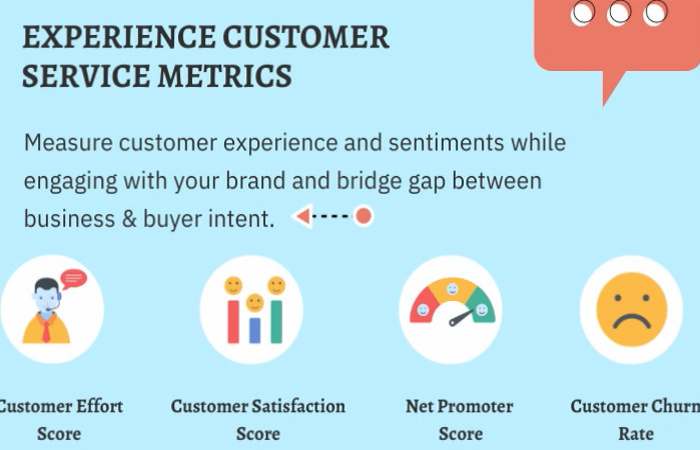
When it is easy for customers, they are usually happier because they like things to be simple and easy which’s what Customer Effort Score is all, about.
First Response Time (FRT)
First Response Time is a measure of how promptly the representatives of the customer service department respond to an initial request of the customer.
SLA compliance indicates the level of consistency with these prearranged service criteria.
How to Measure Service Metrics Correctly
Set Up Goals
Define the business goals you want to reach with your customer service strategy before choosing performance metrics.
Use Quality Sources of Data
Collect information from customer satisfaction surveys, CRM systems, helpdesk software, call center applications, live chats, and other customer support technologies.
Monitor Performance Consistently
- Do not wait until the end of quarter or year to assess the service metrics. Look at the Trends Over Time
- Monitoring of performance trends can help businesses identify progress and problems.
- Communicate Results with Teams
The employees must know their performance targets and get feedback according to service metrics.
Improving Service Metrics through Technology
The technology used in contemporary customer service greatly helps in performance tracking.
Companies apply technology to:
• Taking note of customer interactions
• Measuring response time
• Reporting automatically
• Evaluating customer feedback
• Service ticket management
• Communications improvement
• Creating performance dashboards
• Finding areas for improvement
Service Metrics FAQ
What are service metrics?
Service metrics refer to measurable criteria used to assess the quality of customer service operations in an organization.
Why are service metrics important?
Service metrics give you insight about customer satisfaction, team performance, response time, and operational efficiency.
Which service metrics should your business track?
Some of the most common examples are as follows:
· Customer Satisfaction Score (CSAT),
· Net Promoter Score (NPS),
· First Response Time (FRT),
· Average Resolution Time (ART),
· First Contact Resolution (FCR),
· Customer Retention Rate,
· and SLA Compliance.
How often should you review service metrics?
Service metrics can be tracked on a daily, weekly, or even monthly basis, depending on the amount of customer service that your business handles.
Can small businesses make use of service metrics?
Definitely. Any business can take advantage of service metrics to improve customer satisfaction, team performance, operational efficiency, and growth.
Conclusion
Service metrics play an important role in measuring, managing and continuously improving the quality of customer services. Thanks to various indicators like customer satisfaction, reaction time, rate of solving problems and customer retention, businesses get useful information helping to make better decisions and perform better operations.
Instead of paying attention only to fast reactions from employees, good companies pay attention not only to efficiency but to quality, providing clients with fast, correct and personalized services. The regular analysis of performance, customer feedback, employee training and advanced customer service solutions enable companies to provide great customer experience.
Regardless of whether you have a start-up, developing business or company, using the right approach to service metrics will help you improve customer satisfaction and make your employees more productive.